Slip Bobber vs Fixed Bobber
Oh, the humble bobber! It might seem like a simple piece of fishing gear, but choosing between a slip bobber and a fixed bobber can honestly make or break a fishing trip, especially here in Iowa where we have such a diverse range of waters, from shallow farm ponds to the mighty Mississippi. Many anglers get frustrated trying to decide which one is right for their current situation, leading to tangled lines or missed fish. This guide is here to untangle that confusion, walking you through the ins and outs of both types so you can pick the perfect bobber for your next adventure.
Understanding Fixed Bobbers: The Tried and True Choice
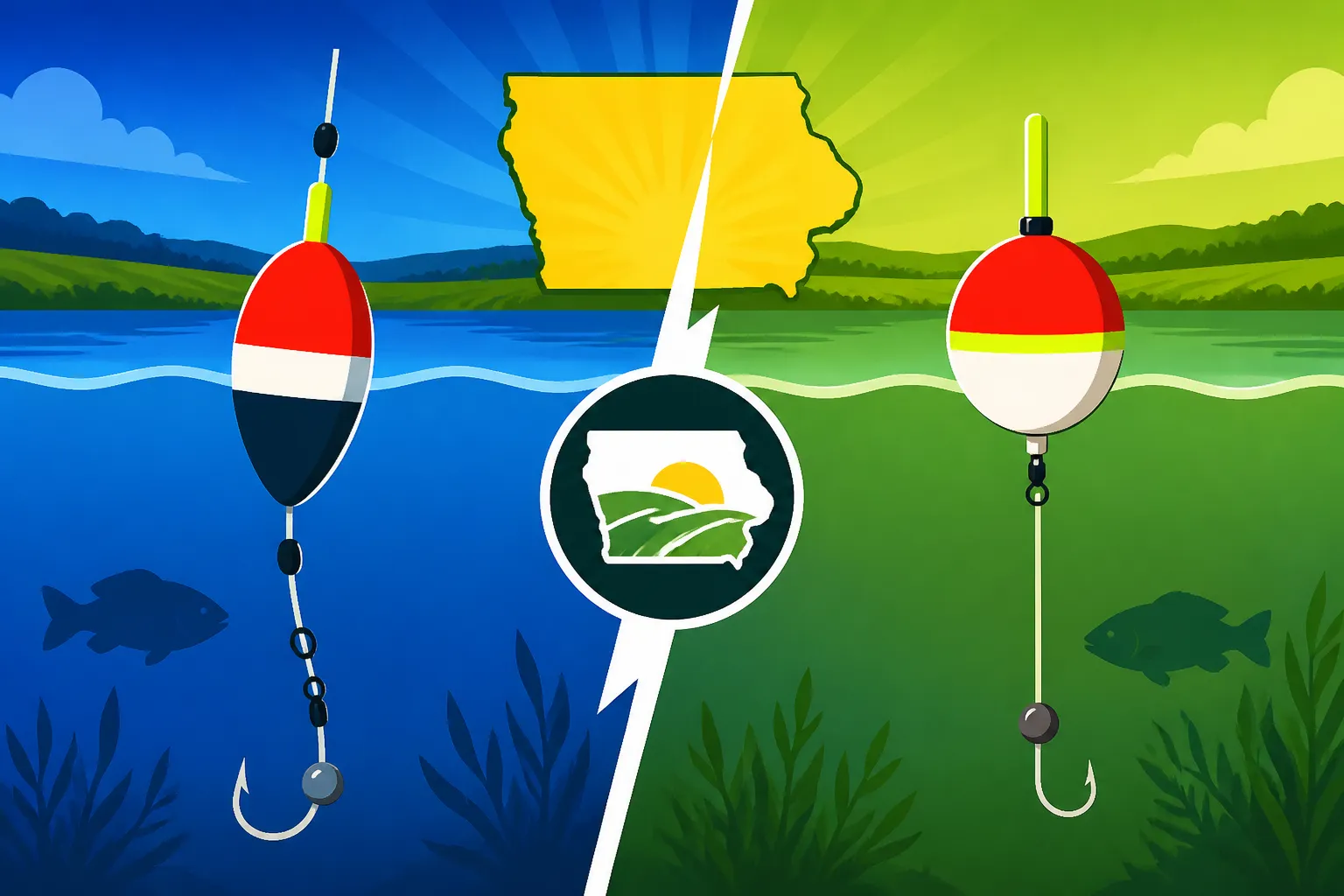
Let's start with the classic, the one many of us probably learned to fish with as kids: the fixed bobber. These are those cheerful red-and-white spherical bobbers, or the long, pencil-shaped ones, that just clip directly onto your fishing line. They're straightforward, no-fuss, and for certain situations, absolutely unbeatable.
The Simplicity of Fixed Bobbers: Great for Beginners and Shallow Water
The beauty of a fixed bobber lies in its sheer simplicity. You pinch it onto your line at a predetermined depth, and that's it! When a fish bites, the bobber dips, twitches, or sails across the water, giving you that unmistakable visual cue to set the hook. This direct feedback is fantastic for beginners, including those excited little anglers on their first Iowa Fishing Trip. There’s no complicated rigging, no extra knots to tie – just clip and cast.
Imagine you're at a local community pond, perhaps one of the Best Family Fishing Ponds Near Cedar Rapids, targeting bluegill or smaller bass. The water is relatively shallow, maybe 4 to 8 feet deep, and you're fishing from the bank or a pier. A fixed bobber is your best friend here. You can easily set your bait a foot or two off the bottom, or suspend it in the middle of the water column where those panfish are often schooling. It's incredibly efficient for presenting small baits like worms or crickets. The fixed position of the bobber means your bait stays right where you want it, giving fish ample time to find and take it. It’s also superb for sight fishing in clear, shallow water, letting you watch the bobber intently for even the slightest interest.
Limitations of Fixed Bobbers: Depth and Casting Woes
While wonderfully simple, fixed bobbers do come with their own set of limitations. The most obvious one is depth. Because the bobber is fixed to your line, the depth you can fish is restricted by how far you can cast with the bobber still attached. If you're trying to fish in 15 feet of water but your rod is only 7 feet long, you're going to have a hard time casting a fixed bobber rig effectively. The bobber and bait will be dangling a good distance below your rod tip, making it awkward and prone to tangles when you try to launch your bait out. It's like trying to swing a jump rope with a brick tied to one end – not very graceful!
This casting challenge becomes especially apparent when you're fishing from shore and trying to reach deeper channels or submerged structure. It also leads to frustrating line tangles, where your hook and sinker might wrap around the line or the bobber itself mid-cast. Another drawback is dealing with current. In rivers like the Des Moines or even the slower sections of the Mississippi River Pool 9 Fishing, a fixed bobber can sometimes be pulled under or dragged too quickly out of the prime fishing zone, making it difficult to maintain a natural drift for species like walleye or catfish. You might find yourself constantly reeling in and re-casting, which isn't exactly a relaxing day on the water.
Diving Deep with Slip Bobbers: Versatility for the Savvy Angler
Now, let's talk about the slip bobber – a true game-changer for anglers looking to fish deeper water, navigate current, or simply cast with greater ease and precision. If you haven't tried them, you're missing out on a whole new dimension of fishing.
How Slip Bobbers Work: Unlocking Deeper Water
A slip bobber gets its name because, unlike a fixed bobber, it slips freely up and down your fishing line. The magic happens with a tiny piece of string or rubber called a "bobber stop" that you tie or cinch onto your main line. Above the bobber stop, you usually thread a small bead (to protect the knot and allow the bobber to slide smoothly), and then the slip bobber itself. Below the bobber, you have your weight and hook.
Here’s how it transforms your fishing: when you cast, the bobber slides all the way down to your weight, creating a compact, aerodynamic package. This allows for much longer, more accurate, and less tangled casts, even with a long leader and your bait set to fish 20 or 30 feet deep. Once your rig hits the water, the weight pulls your bait down, and the bobber "slips" up the line until it hits that bobber stop. Voila! Your bait is now suspended at the exact depth you set, regardless of how deep you cast.
This ability to fish at virtually any depth makes slip bobbers indispensable for targeting fish like crappie suspended over deep brush piles, walleye hugging drop-offs in the Iowa Great Lakes, or even channel catfish in deep river holes. It allows for a more natural presentation, as your bait can slowly sink and then hover, mimicking natural forage. For serious anglers looking to master techniques like Trolling for Crappie in Iowa or How to Catch Walleye in Iowa, a slip bobber is often a key piece of the puzzle.
When to Use a Slip Bobber: From Rivers to Reservoirs
The versatility of the slip bobber truly shines in a variety of Iowa fishing scenarios. If you're out on a large body of water like Rathbun Lake in Iowa or Saylorville Reservoir in Iowa, and your sonar is showing fish suspended 15-25 feet down, a slip bobber is precisely what you need. You can precisely set your depth to present your lure right in their strike zone. This is especially effective when fish are holding to specific contours or feeding lanes that fixed bobbers just can't reach easily.
Consider river fishing as well. On the deeper stretches of the Des Moines River, where catfish might be holding in holes or sauger are found in current seams, a slip bobber allows your bait to drift naturally at a set depth without being pulled under by strong currents. You can feed line out and let your bait drift a considerable distance, covering more water and enticing more bites. Ice fishing is another prime example; when you're dropping a line through a small hole, a slip bobber allows you to adjust your depth quickly and easily without having to re-tie or struggle with extra line. This makes them ideal for Ice Fishing in Iowa, particularly when targeting crappie or bluegill that might be suspended at various depths under the ice.
The Setup Showdown: Getting Your Rig Just Right
Knowing the difference between fixed and slip bobbers is one thing, but actually rigging them up correctly is another. Let's walk through how to set up each one, and you'll quickly see why one might be a better fit than the other for certain situations.
Rigging a Fixed Bobber: Quick and Easy
Setting up a fixed bobber is about as simple as it gets. It's often the go-to for kids because it requires minimal fuss.
- Choose Your Bobber: Select a bobber appropriate for your bait and the conditions. Smaller, lighter bobbers are better for lighter baits and subtle bites, while larger ones can support heavier bait and be seen from further away.
- Thread Your Line: Pass your main fishing line through the spring-loaded clip or the small eyelet on the top of the bobber.
- Attach to Line: Pinch the spring clip (if it's that style) and pull your line into the slot, then release the clip. For eyelet styles, you might have a small pin or wedge that locks the line in place.
- Add Weight: Crimp one or more small split-shot sinkers a foot or so above your hook. The goal is to add just enough weight to make your bait sink and stand the bobber up properly, but not so much that it pulls the bobber completely under.
- Tie on Hook: Tie your hook to the end of your line. A simple Palomar or Improved Clinch knot usually works great.
- Set Depth: Adjust the bobber up or down the line to achieve your desired fishing depth. Remember, this depth is limited by your rod length and casting ability.
That's it! You're ready to cast. This simple setup is perfect for small, still waters where you're fishing relatively shallow. It’s also often favored for Bluegill Fishing in Iowa in quiet coves or shallow margins.
Rigging a Slip Bobber: A Few More Steps, Worth the Effort
While a slip bobber rig involves a couple more components, the increased versatility it offers makes the extra steps completely worthwhile.
- Tie on Bobber Stop: This is the most critical first step. Take a bobber stop (these can be small pieces of string, rubber bands, or plastic beads that cinch tightly onto your line) and slide it onto your main line. Many anglers keep a supply of these handy in their tackle box, often bought in packs from Bass Pro Shops or Amazon. Make sure to cinch it down firmly but gently, so it doesn't damage your line.
- Add the Bead: Immediately after the bobber stop, thread a small plastic or glass bead onto your line. This bead acts as a buffer, protecting your bobber stop knot from wear and tear as the bobber slides up and down. It also ensures the bobber doesn't get stuck on the knot.
- Thread the Slip Bobber: Pass your main line through the eyelet or tube at the bottom of the slip bobber, and then out through the eyelet at the top.
- Add Weight: Attach your sinker(s) – usually a split shot or a small egg sinker – about a foot above where your hook will be. Again, use just enough weight to help your bait sink and stand the bobber upright.
- Tie on Hook: Secure your hook to the end of your line.
- Set Depth: To set your depth, simply slide the bobber stop knot up or down your line. When you cast, the bobber will slide down to your weight, making casting easy. Once in the water, it will rise until it hits that stop, positioning your bait exactly where you want it.
This setup is ideal for fishing deeper spots, like those found when Fishing the Iowa Great Lakes for walleye or targeting suspended crappie. The ease of casting and the ability to precisely control depth are unmatched.
Choosing Your Weapon: Matching Bobber to Fishing Conditions
Now that you know the mechanics of both, how do you decide which one to use? It all boils down to the specific conditions you're facing on the water.
Situational Choices: Knowing When to Switch
Picking the right bobber isn't just a preference; it's a strategic decision based on several key factors:
- Water Depth: This is perhaps the biggest differentiator. If you're fishing less than 8-10 feet deep and want a simple setup, a fixed bobber is often fine. But if you need to go deeper than your rod length, or if the fish are suspended at unknown depths you need to explore, a slip bobber is absolutely essential.
- Casting Distance: Need to cast a long way to reach that submerged rock pile or weed line? A slip bobber will give you a much smoother, further cast without tangles. Fixed bobbers are best for shorter, more precise casts.
- Current: In moving water, like rivers or windy lakes, a fixed bobber can struggle. A slip bobber, especially when paired with enough weight to keep your bait down, can allow for a more natural drift and better control over your bait's presentation. However, sometimes a fixed bobber on a lighter rig can be purposefully used to let a bait drift with the current in a very specific, shallow channel.
- Target Species: Panfish in shallow ponds? Fixed bobber. Deep-holding walleye or crappie? Slip bobber. Catfish in river channels? Often a slip bobber for depth control or sometimes a fixed one for specific shallow drifts. Thinking about How to Catch Crappie in Iowa? A slip bobber is often key for hitting suspended schools.
- Bait Presentation: Do you want your bait to hang perfectly still, or do you want it to have a more natural, slow fall? Slip bobbers allow for a natural fall until the bobber stop is hit, while fixed bobbers hold it immediately.
| Feature | Fixed Bobber | Slip Bobber |
|---|---|---|
| Ease of Setup | Very easy, few components | Slightly more involved, requires bobber stop |
| Max Fishing Depth | Limited by rod length and casting comfort | Unlimited, can fish very deep waters |
| Casting Ability | Shorter, more prone to tangles on long casts | Longer, smoother casts, less tangling |
| Current Handling | Can be pulled under or drift too quickly | Better control, allows natural drift at set depth |
| Ideal For | Shallow water, still water, beginners, kids, close-range panfish | Deep water, moving water, targeting suspended fish, longer casts, experienced anglers |
| Common Species | Bluegill, smaller bass, sunfish | Walleye, crappie, catfish, deeper bass |
Iowa Scenarios: Fixed vs. Slip in Action
Let's put this into perspective with some real-world Iowa fishing examples.
Imagine you're taking your grandkids to a small, private farm pond, maybe one of those Best Farm Ponds for Bass Fishing that's only 5-10 feet deep. You're throwing a small worm or a piece of corn. A fixed bobber is perfect. It's simple, visual, and helps those little hands feel confident when they see it disappear. No need for complex rigging; just clip it on, toss it out, and watch for the bite.
Now, shift gears. You're on the Cedar River, perhaps doing some Kayak Fishing Techniques in Iowa, and you're marking schools of white bass and crappie holding at 12 feet over a 20-foot channel. You need to cast your jig a good distance upstream and let it drift naturally into the school. A fixed bobber here would be a nightmare. It would be impossible to cast that deep, and the current would drag it awkwardly. This is where your slip bobber shines. You set your bobber stop to 12 feet, cast upstream, and let the current carry your bait right into the heart of the school. The bobber pops up, you get a bite, and the fight is on!
Or think about the pursuit of those elusive Walleye Fishing in Iowa during the cooler months. Walleye often hold tight to structure in deeper water, sometimes 20 feet or more down in a reservoir like Coralville. Trying to get a bait to them with a fixed bobber from shore would be a futile exercise. A slip bobber allows you to present a live minnow or a jig precisely at their depth, whether you're fishing from a boat or from a deep bank access point. This precision is key to consistently catching these notoriously finicky biters.
In conclusion, both fixed and slip bobbers have their place in an Iowa angler's tackle box. Don't fall into the trap of thinking one is inherently "better" than the other. Instead, understand their strengths and weaknesses, and you'll be well-equipped to choose the right tool for whatever fishing situation Mother Nature throws your way. Having both types rigged and ready, or at least the components for both, will make you a much more adaptable and successful angler on Iowa's diverse waters.
Disclaimer
This article is for general informational purposes only and does not constitute professional advice. Laws, prices and regulations vary by location and change over time. Consult a qualified professional for guidance on your specific situation.