Jon Boat vs Bass Boat for River Fishing
Oh, the age-old dilemma of choosing the right boat for river fishing in Iowa! It's a question that keeps many of us anglers up at night, staring at boat listings online, especially when you're trying to decide between a rugged, dependable jon boat and a sleek, high-performance bass boat. You want something that can handle those tricky river currents, get you into the honey holes, and not break the bank, right? This guide is here to walk you through the ins and outs of both options, helping you figure out which vessel will truly become your trusty companion on Iowa's fantastic waterways.
Understanding Iowa's River Fishing Landscape
Before we even dive into the boats themselves, let's talk about the unique challenges and joys of river fishing here in Iowa. Our rivers aren't all the same, and what works perfectly on a wide, calm stretch of the Mississippi might be a nightmare on a shallow, snag-filled tributary. Understanding these nuances is key to making an informed boat choice.
The Diverse Nature of Iowa Rivers
Iowa boasts an incredible network of rivers, each with its own personality. You've got the grand, expansive waters of the Mississippi River, often feeling more like a series of lakes in places with its diverse backwaters, main channel, and wing dams. Then there are the winding, often shallower inland rivers like the Des Moines, Cedar, or Iowa Rivers, which can present a totally different set of conditions. These smaller rivers might have more current, more submerged timber, and frequent shallow spots that can test any boat's limits. It's a real mixed bag out there, and your ideal boat really depends on where you plan to spend most of your time.
Anglers often face scenarios where one river system is perfect for larger crafts, while another demands something much more agile and less prone to getting stuck. Think about the difference between navigating Fishing the Mississippi River in Iowa versus a smaller, more intimate river where you're constantly dodging logs and sandbars. Each requires a specific approach, not just in fishing technique but in vessel choice too.
Common River Fishing Challenges
River fishing isn't always smooth sailing. One of the biggest challenges is fluctuating water levels. After heavy rains, rivers can swell, creating strong currents and bringing down debris. Conversely, during dry spells, those same rivers can drop to incredibly shallow depths, exposing sandbars and making navigation a minefield. Submerged obstacles like logs, rocks, and old concrete structures are also common, posing a constant threat to props and hulls. This dynamic environment means you need a boat that can take a beating and keep on floating, or at least one that can easily be repaired.
Another factor is access. Not all river spots have paved boat ramps. Sometimes, you're launching from a muddy bank or dragging your boat a short distance over rough terrain. If you're chasing that elusive Channel Catfish Daily Limit in Iowa in a remote spot, you might not have the luxury of a pristine launch. This reality often dictates the size and weight of the boat you can realistically operate and transport.
Decoding the Jon Boat: Simplicity and Practicality
For many seasoned Iowa river anglers, the jon boat is practically a staple. It's the workhorse, the no-frills option that often gets the job done without complaining. Let's dive into what makes these boats so appealing, and where they might fall short.
What is a Jon Boat?
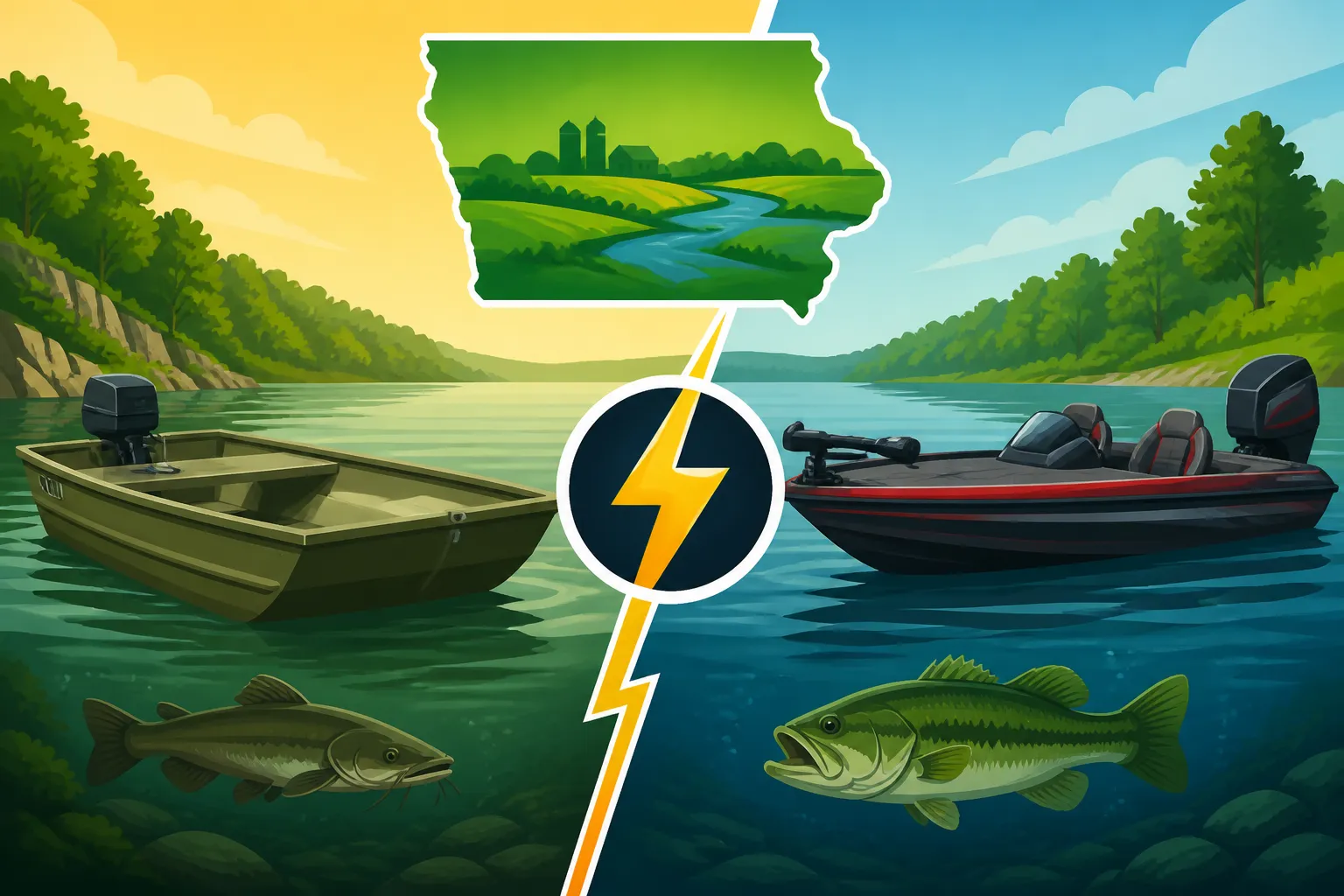
A jon boat is characterized by its flat bottom, shallow draft, and typically aluminum construction. They're usually quite open, with bench seating and a tiller-steer outboard motor, though some larger models might feature a side console. Their design prioritizes stability in calm, shallow water and ease of maneuverability. You'll often see them in lengths ranging from 10 to 20 feet, though smaller ones are common for individual anglers or those fishing very tight spots.
They're like the pickup truck of the fishing world – rugged, versatile, and dependable, designed to handle the bumps and scrapes that come with river life. Many anglers start their boating journey with a jon boat due to their relative simplicity and lower entry cost. Whether you're chasing Catfish Limit on Rathbun Lake or just exploring quiet backwaters, a jon boat is often up to the task.
Advantages of a Jon Boat for River Fishing
The benefits of a jon boat for Iowa river fishing are numerous and often come down to practicality.
- Shallow Draft: This is arguably their biggest selling point. With their flat bottom, jon boats can navigate incredibly shallow water without getting hung up. This is a huge advantage on Iowa's ever-changing rivers, allowing you to access remote backwaters and sneak over sandbars that would stop a deeper-hulled boat in its tracks. Imagine idling through just a few inches of water to reach a secluded crappie hotspot – that's a jon boat's domain.
- Durability and Repairability: Most jon boats are made from aluminum, which is tough and relatively easy to repair if you ding it on a rock or log. Unlike fiberglass, which can require specialized repairs, a skilled welder can usually patch up aluminum quite effectively. This means less worry when you inevitably encounter submerged hazards in a river.
- Affordability: Generally speaking, jon boats are far less expensive to purchase and maintain than bass boats. The initial cost for the hull and a suitable outboard is significantly lower, making them an excellent choice for anglers on a budget or those just getting into boat ownership. Maintenance is also simpler, with fewer complex systems to worry about. You'll also likely find the Iowa Boat Registration Cost to be more manageable for these smaller, simpler vessels.
- Versatility: While excellent for fishing, jon boats can also serve many other purposes, from duck hunting to simply navigating shallow areas for recreation. They are truly multi-purpose vessels, making them a great value for those who enjoy a variety of outdoor activities.
Disadvantages of a Jon Boat for River Fishing
Despite their many pros, jon boats do have some notable drawbacks that can affect your fishing experience.
- Rough Water Performance: The flat bottom that makes them excel in shallow water is also their Achilles' heel in choppy conditions. When you hit waves, a jon boat tends to "slap" the water, creating a jarring, wet, and uncomfortable ride. This can be particularly unpleasant on larger rivers like the Mississippi when barges pass or on windy days. If you're planning to run long distances on rougher water, a jon boat might leave you feeling pretty beat up.
- Lack of Features and Comfort: Jon boats are typically Spartan. They often lack built-in rod storage, livewells, comfortable seating, or advanced electronics mounting options. While you can certainly customize them (and many anglers do!), out of the box, they offer minimal creature comforts. Long days on the water can become tiring without proper seating or places to keep your gear organized.
- Speed Limitations: While they can get around, jon boats aren't built for speed. Their hull design isn't aerodynamic for quick planing, and they often use smaller, less powerful outboards. If you're looking to cover a lot of ground quickly or participate in bass tournaments where speed is a factor, a jon boat will feel sluggish. They are designed more for poking around rather than racing from spot to spot.
Unpacking the Bass Boat: Performance and Specialization
Now, let's shift gears to the bass boat – the flashy, high-octane choice designed with one primary purpose in mind: tournament bass fishing. While not always the first thought for river anglers, they do bring a lot to the table.
What is a Bass Boat?
A bass boat is a highly specialized fishing machine. They are typically made of fiberglass, featuring a V-hull design, powerful outboard motors (often 100+ horsepower), and a low-profile, wide stance. They come loaded with features like massive livewells, multiple rod lockers, expansive casting decks, and advanced electronics. Their primary goal is speed, stability at speed, and maximum fishability for serious anglers, especially those targeting Largemouth Bass Fishing in Iowa or other aggressive species.
These boats are designed for a singular pursuit, which is why they are often seen as the ultimate tool for competitive anglers. They are built for performance, with every detail considered to maximize efficiency on the water.
Advantages of a Bass Boat for River Fishing
When considering a bass boat for river fishing, especially on larger Iowa rivers, several advantages stand out.
- Speed and Range: If you need to cover significant distances on the Mississippi River or other larger waterways, a bass boat is king. Their powerful engines allow for rapid transit between fishing spots, maximizing your time with lines in the water. This speed can be crucial for tournament anglers or those who simply want to explore far-flung honey holes in a single day. You can be at your first spot quickly, and then zoom to the next without wasting precious fishing time.
- Comfort and Features: Bass boats are decked out with angler-friendly amenities. We're talking plush seating, dry storage compartments for all your gear, huge livewells to keep your catch healthy, and often integrated electronics like fish finders and GPS. The large, flat casting decks provide a stable platform for pitching and flipping, making your long days on the water much more comfortable and efficient. Having everything organized and within reach makes a huge difference.
- Improved Rough Water Handling: While no small boat is perfectly comfortable in truly rough water, the V-hull design of a bass boat generally handles chop much better than a flat-bottomed jon boat. They cut through waves rather than slapping over them, providing a smoother, drier ride. This is a significant advantage if you frequently fish large, open stretches of river where wind and boat traffic can create substantial waves.
Disadvantages of a Bass Boat for River Fishing
Despite their performance, bass boats come with a set of notable drawbacks, particularly when applied to the diverse conditions of Iowa rivers.
- Shallow Water Limitations: This is the most significant hurdle. The V-hull design and deeper draft of a bass boat mean they can't operate in the extremely shallow water a jon boat can. You'll constantly be worrying about your lower unit hitting bottom in backwaters or when crossing sandbars. Many prime river fishing spots, especially on smaller Iowa rivers, are simply inaccessible to a traditional bass boat. This can severely limit your options and force you to stick to deeper channels.
- Cost and Maintenance: Bass boats are considerably more expensive to buy, rig, and maintain. The powerful engines require more fuel and more frequent, specialized servicing. Insurance can be higher, and repairs to fiberglass hulls are often more complex and costly than aluminum. The initial investment is substantial, and the ongoing costs can add up quickly, making them a less accessible option for many. You'll want to check current prices for top-of-the-line gear at places like Bass Pro Shops or compare deals on the used market.
- Durability Concerns for River Obstacles: While strong, fiberglass hulls can be more susceptible to damage from submerged logs and rocks than aluminum. A direct hit could mean a serious crack or hole, leading to expensive repairs and significant downtime. This constant worry can detract from the enjoyment of fishing in snag-prone river environments. Dragging a bass boat over a muddy bank or gravel launch is also a definite no-go.
Key Considerations for Your River Fishing Style
Now that we've laid out the general characteristics of both boat types, let's get down to the nitty-gritty of how they align with your specific fishing needs and the realities of Iowa's rivers. This is where you really need to be honest with yourself about your priorities.
Depth and Navigability
This is perhaps the single most critical factor for Iowa river fishing. Are you primarily fishing the main channel of the Mississippi, or are you hoping to explore tight, shallow creeks and backwaters?
If your heart is set on those skinny waters where big Channel Catfish Fishing in Iowa often hide in the summer or where Crappie and Sunfish Limits in Iowa are found around submerged structure, a jon boat's shallow draft is almost indispensable. You can literally pole or use a trolling motor in inches of water, getting to places no bass boat would ever dare. However, if your target is mainly on wider, deeper stretches, or if you plan to stick to well-marked channels, a bass boat might work. But even then, many prime river spots on the Mississippi involve navigating through shallower backwaters to get to productive areas, which can be a serious limitation for a bass boat.
Consider the reality of river fluctuations: a spot that's navigable in spring might be impassable in late summer. A jon boat gives you much more flexibility in these unpredictable conditions.
Speed vs. Stealth
Do you need to blast across miles of open water to beat other anglers to a spot, or do you prefer a quiet, slow approach, methodically working your way through cover?
Bass boats, with their powerful engines, are built for speed. They excel at getting you to a distant wing dam or sand flat quickly. This is a huge advantage if you're chasing migratory species or fishing large impoundments upstream from river stretches. However, their speed often comes with more noise, which can be a factor in spooking fish in shallower, clearer waters. Plus, navigating fast at low water can be downright dangerous.
Jon boats, on the other hand, are inherently slower but offer incredible stealth, especially when paired with an electric trolling motor. You can slowly creep into prime areas, minimizing disturbance, which is often crucial for wary fish. For many types of river fishing, particularly in quieter areas or when sight fishing, a stealthy approach often outperforms sheer speed. Think about easing into a peaceful bend on the Des Moines River, quietly casting for Smallmouth Bass Fishing in Iowa.
Comfort and Features vs. Simplicity
Think about how you fish and what makes you comfortable on the water for hours on end.
A bass boat offers unparalleled comfort and convenience with its specialized features. If you value a smooth ride, ample space for multiple rod setups, organized tackle storage, and advanced electronics (and the power to run them all day), then a bass boat offers a premium experience. These are designed for the serious angler who spends countless hours on the water and demands a high level of efficiency. You can easily outfit them with top-tier Fish Finders and Electronics for Iowa Anglers.
However, the simplicity of a jon boat can also be its own kind of comfort. Less to break, less to clean, less to worry about. For many, the stripped-down nature allows them to focus purely on the fishing. While you can add aftermarket accessories, a jon boat doesn't come with the expectation of a high-tech setup. This minimalist approach often translates to less stress and more pure enjoyment of the outdoors. If you're someone who likes to keep things simple, a jon boat might be more your speed.
Budget and Maintenance
Let's talk dollars and cents, because for most of us, this is a major deciding factor.
Initial Cost: A new, fully rigged bass boat can cost as much as a new car, sometimes even more. Even used models can represent a significant investment. Jon boats, by contrast, are far more budget-friendly. You can often find a decent used jon boat with a reliable outboard for a fraction of the cost of a bass boat. Even new, the price difference is substantial. You might be able to find a suitable setup for a jon boat within a reasonable budget on platforms like Amazon, or from local dealers.
Operating Costs: Fuel, insurance, maintenance, and storage costs are all higher for a bass boat. Their powerful engines burn more gas, and specialized parts and service come at a premium. Jon boats are generally cheaper to run and easier to maintain yourself. If you're looking for a boat that won't continuously drain your wallet after the initial purchase, the jon boat is typically the clear winner here.
Here's a quick comparison table to help visualize these differences:
| Feature/Aspect | Jon Boat | Bass Boat |
|---|---|---|
| Hull Type | Flat Bottom | V-Hull |
| Primary Material | Aluminum | Fiberglass (mostly) |
| Shallow Water | Excellent (Very shallow draft) | Poor (Deeper draft, risk of prop/hull damage) |
| Rough Water | Poor (Rough, wet ride) | Good (Cuts through chop, smoother ride) |
| Speed | Low to Moderate | High (Built for speed) |
| Features | Basic, customizable, utilitarian | Loaded with specialized fishing features |
| Comfort | Minimal (Can be customized for more) | High (Ergonomic seating, spacious decks) |
| Durability | Very Durable, easy to repair dents | Strong, but more prone to costly fiberglass damage |
| Cost (Initial) | Lower | Much Higher |
| Operating Cost | Lower (Fuel, maintenance, insurance) | Higher (Fuel, specialized maintenance, insurance) |
| Target Rivers | Shallow, snaggy, smaller, diverse access | Larger, deeper, open water, good access |
| Typical Use | General fishing, hunting, utility, exploration | Dedicated tournament fishing, competitive angling |
Making the Right Choice for Your Iowa Adventures
Ultimately, the best boat for you comes down to a personal assessment of your fishing habits, the types of rivers you frequent most, and your budget. There's no universal "best," only what's best for you.
Assess Your Primary Fishing Grounds
- Mississippi River Angler: If you spend most of your time on the main channel of the Mississippi, particularly from pool to pool, and need to cover ground quickly, a bass boat might be a tempting choice for its speed and rough water capabilities. However, if you're like many and love exploring the backwaters, navigating through stump fields, and accessing those shallow coves, a jon boat will be much more versatile and less stressful to operate. For dedicated backwater fishing, the jon boat clearly wins. For diverse fishing across the entire river system, you'll constantly be balancing the pros and cons. Remember, Fishing Regulations on the Mississippi River Border can also influence where you choose to fish.
- Inland River Explorer: For rivers like the Des Moines, Cedar, or Iowa, which are often shallower, narrower, and full of snags and fluctuating water levels, the jon boat is generally the superior choice. Its ability to run in skinny water and withstand bumps and scrapes makes it ideal for these environments. A bass boat here would be a constant source of anxiety and frustration, likely limiting you to only the deepest, most open stretches.
- Mixed Bag Angler: If you fish a variety of water types, you might have to make a compromise. Perhaps a larger, wider jon boat with a more powerful (but still modest) outboard could bridge the gap, offering more stability and a slightly smoother ride than a smaller jon boat, while still retaining shallow-water capability.
Consider Your Fishing Style and Priorities
Are you a competitive angler who needs every edge, including speed and specialized features? Or are you a more laid-back angler who values simplicity, stealth, and access to hard-to-reach spots?
If your passion is competitive bass fishing and you're always trying to shave minutes off your travel time between spots, then the performance and features of a bass boat are tailored for that. However, if your joy comes from quietly exploring hidden coves, getting into places others can't, or simply enjoying a peaceful day on the water without the constant worry of damaging expensive equipment, a jon boat is probably a better fit. Many anglers find the zen of Shore Fishing Techniques for Beginners or slowly working a shoreline from a jon boat to be far more rewarding.
The Hybrid Approach: Customizing a Jon Boat
Don't forget that jon boats are incredibly customizable. Many anglers trick out their jon boats to add features found on bass boats, creating a hybrid that maximizes their river fishing potential. You can add:
- Casting Decks: Build elevated platforms for better visibility and casting.
- Rod Holders & Storage: Install vertical or horizontal rod holders, or even build locking rod lockers.
- Livewells: Add portable or built-in livewells.
- Comfortable Seating: Replace bench seats with swivel chairs or pedestal seats.
- Electronics: Mount a trolling motor, fish finder, and GPS. For accessories, don't forget to check out what's available on Amazon or specialized stores like Bass Pro Shops.
This approach allows you to tailor a boat specifically to your needs, often at a much lower cost than a bass boat, and still retain the shallow-water advantages of the jon boat hull. It's about getting the best of both worlds without breaking the bank or sacrificing your ability to fish the unique waters of Iowa.
Maintenance and Ownership: Beyond the Purchase
Owning any boat involves ongoing responsibilities, and it’s important to think about these aspects as they can significantly impact your overall experience and budget.
Jon Boat Maintenance Realities
Maintaining a jon boat is typically a straightforward affair. Since they are often simpler in design, there are fewer complex systems to troubleshoot. Aluminum hulls are incredibly resilient to impacts from logs or rocks that are common in rivers. While a hard hit might cause a dent, they rarely compromise the integrity of the boat in a catastrophic way. Small leaks can often be patched with basic welding or even marine-grade epoxies.
Outboard motors on jon boats are usually smaller and less complex, leading to lower service costs and easier DIY maintenance for things like spark plugs or fuel filters. Storage is also easier; their flat bottoms mean they can be stored directly on trailers or even pulled up onto a bank. How to Winterize a Boat Battery for Iowa Winters and general engine care are important for any boat, but often less intensive for a jon boat. You're less likely to need specialized tools or expert technicians for routine upkeep.
Bass Boat Maintenance Commitments
Bass boats, being more complex and high-performance machines, demand a higher level of maintenance commitment. Their powerful outboards require regular professional servicing to ensure optimal performance and longevity. Fuel systems can be more intricate, and the fiberglass hull, while sleek, can suffer from gel coat cracks or structural damage from impacts, requiring specialized and often expensive repairs. Keeping the electrical systems, livewells, and advanced electronics in top shape also requires diligent attention.
Cleaning and detailing a bass boat also takes more effort to maintain its aesthetic appeal, especially with a fiberglass finish. Storage considerations can also be more stringent, often requiring a covered space to protect the boat from the elements. While they offer superior performance, that performance comes with a price, not just in initial purchase but in ongoing care. This can mean more time spent on maintenance and potentially less time actually fishing if issues arise.
Getting on the Water Legally
Regardless of your choice, remember that proper registration and safety equipment are non-negotiable in Iowa. Make sure you understand Iowa Boat Registration Requirements for your vessel's size and motor type. You'll also need to have all the necessary safety gear on board, including life jackets, a fire extinguisher, and sound-producing devices. If you're considering a more powerful bass boat, you'll also want to look into Boater Education Requirements for Young Anglers if you have aspiring captains in your family. Being prepared and compliant means you can enjoy your time on the water without unnecessary worries.
This article is for general informational purposes only and does not constitute professional advice. Laws, prices and regulations vary by location and change over time. Consult a qualified professional for guidance on your specific situation.