Crappie vs Bluegill Identification
It can be incredibly frustrating to be out on the water, reeling in what you think is a fantastic panfish, only to pull it closer and second-guess yourself. Is it a crappie, or is it a bluegill? This common confusion plagues many Iowa anglers, making it tough to know if you're targeting the right species or even staying within bag limits. This comprehensive guide will clear up that confusion once and for all, providing you with detailed visual and behavioral clues to confidently identify both crappie and bluegill in Iowa's abundant waters.
Why Telling Them Apart Matters
Beyond just knowing what you've caught, understanding the differences between crappie and bluegill is vital for a successful and compliant fishing trip in Iowa. These aren't just minor distinctions; they impact everything from where you fish to the gear you choose and, most importantly, how you adhere to local regulations.
Different Habitats and Behaviors
While both crappie and bluegill are popular panfish, they often prefer slightly different parts of a lake or river, and their behaviors can vary. Crappie, particularly black crappie, tend to be more associated with submerged brush piles, standing timber, and weed lines in deeper water. They're often found suspended in the water column, especially during the colder months or in the heat of summer. Knowing this means you'll focus your efforts on these types of structures if crappie are your target.
Bluegill, on the other hand, often stick closer to shorelines, docks, and shallower weed beds. They love to cruise the edges, especially where there's cover from predators and plenty of aquatic insects to munch on. Their spawning beds are usually visible saucer-shaped depressions in shallow, sandy, or gravelly areas. Understanding these preferences helps you choose your fishing spots more wisely, rather than just casting blindly. If you're looking for where these fish typically hang out, our guide to Bluegill Fishing in Iowa and Crappie Fishing in Iowa offers even more specific insights.
Regulation and Bag Limit Differences
This is perhaps the most critical reason to be able to tell these two panfish apart. While both are considered "panfish," Iowa's fishing regulations can sometimes differentiate between them, especially concerning daily bag limits. Catching an excess of one species when you thought it was another could lead to an unfortunate violation, and nobody wants that on a peaceful fishing day.
It's not uncommon for different species to have varying limits, depending on the body of water or statewide rules designed to manage fish populations effectively. For instance, you'll find distinct rules governing the number of crappie you can keep in a day versus bluegill. Always check the current Iowa fishing regulations booklet or the official Iowa DNR website before heading out. Our articles on Crappie Daily Limit in Iowa and Bluegill and Sunfish Combined Limit can provide a good overview, but always double-check the latest official sources. Being knowledgeable about these distinctions ensures you’re a responsible angler and helps preserve these valuable fisheries for everyone to enjoy.
Visual Cues: The Head and Mouth
One of the quickest ways to start distinguishing between a crappie and a bluegill is by looking closely at their head shape and, more specifically, their mouths. These features give us strong clues about their feeding habits and are consistent across individuals.
Crappie's Large, Protruding Mouth
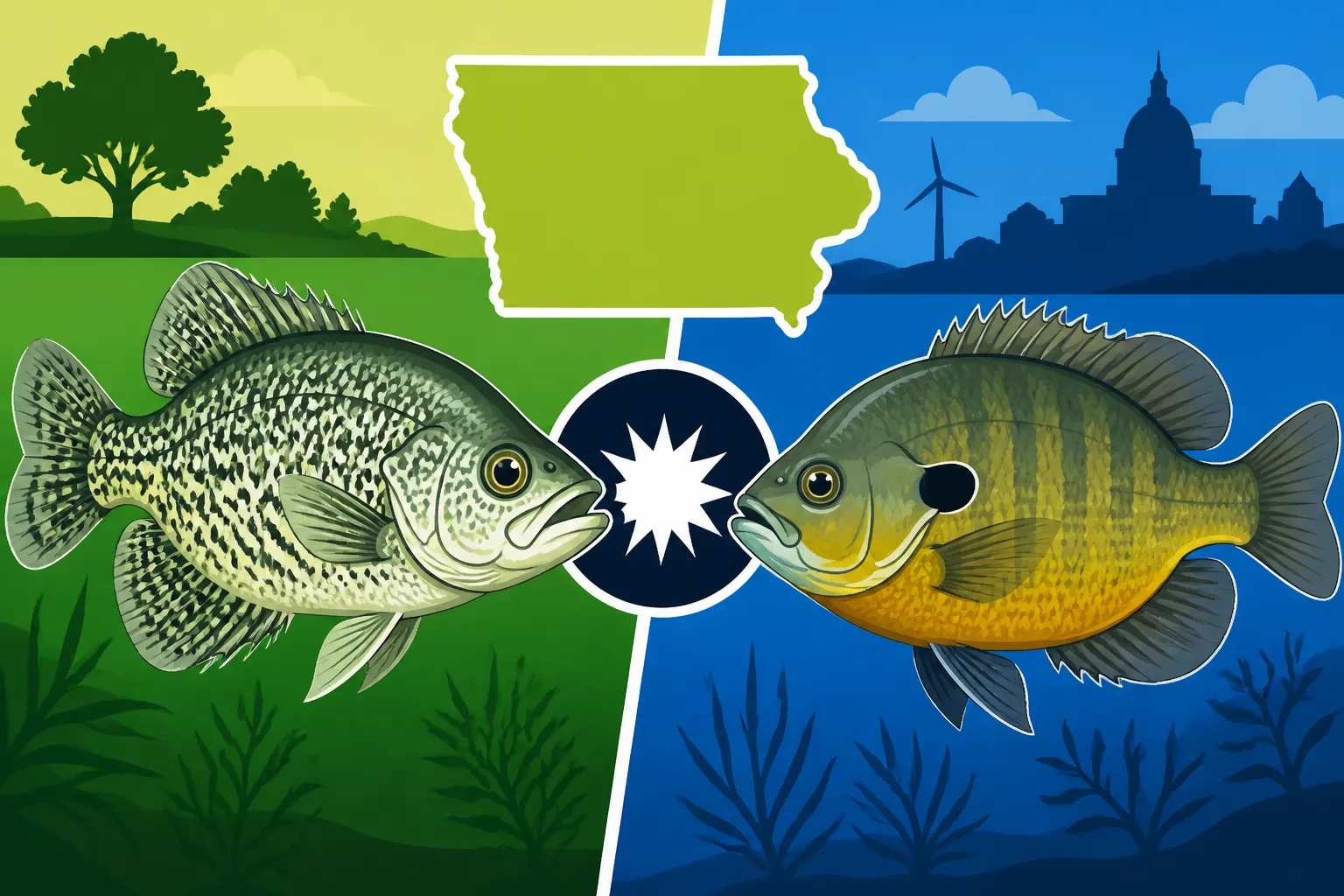
Imagine a fish that looks like it's constantly ready to vacuum up a meal – that's often a crappie. Both black crappie and white crappie (which our guide on Black Crappie vs White Crappie in Iowa delves into) possess a relatively large mouth compared to the size of their head. This mouth extends well past the front of their eye, giving it a somewhat "protruding" or "shovel-like" appearance. It's perfectly adapted for ambushing smaller baitfish or insects, allowing them to engulf their prey quickly.
When you're holding a crappie, take a moment to gently open its mouth. You'll notice it's quite spacious, almost like a scoop. This design is what makes them such effective predators on minnows and small jigs. This larger mouth is a primary characteristic that sets them apart from their bluegill cousins, and once you get an eye for it, it's hard to unsee. If you're ever in doubt, this mouth characteristic is a strong indicator you've got a crappie on your line.
Bluegill's Small, Terminal Mouth
Now, shift your focus to the bluegill. Their mouth is noticeably smaller, often described as a "terminal" mouth, meaning it's located right at the very front end of their head. Crucially, a bluegill's mouth typically does not extend past the front of its eye. In fact, it's usually quite a bit shorter, giving them a more compact, almost "pursed" look.
This smaller mouth tells you a lot about a bluegill's diet. They're primarily insect eaters, nibbling on aquatic invertebrates, larvae, and small plant matter. They aren't built for gulping down larger baitfish like crappie are. When you're fishing for bluegill, you'll typically use much smaller hooks and baits, like tiny worms or micro jigs, precisely because their mouths are so petite. This distinction in mouth size is perhaps the most reliable initial identifier. You can often find an assortment of small panfish baits and hooks perfect for bluegill on online retailers like Amazon.
Body Shape and Scale Patterns
Beyond the head and mouth, the overall body shape and the way their scales appear can provide crucial differentiating clues. These elements contribute to their distinct profiles in the water and how they maneuver.
Crappie's "Dinner Plate" Body
When you hold a crappie, you'll often notice it has a very distinct, almost compressed body shape. Anglers affectionately refer to this as a "dinner plate" profile because they are relatively tall from dorsal fin to belly, but quite thin from side to side. It gives them a streamlined, almost disc-like appearance, especially for their length. This body shape allows them to navigate through dense cover like brush piles and weed beds with surprising agility.
Their scales tend to be smoother and more uniform, often giving them a "slippery" feel. While the overall color can vary depending on water clarity and diet, the fundamental shape remains consistent. This flattened, tall body is a hallmark of the crappie species found throughout Iowa's lakes and reservoirs. It's a key feature to look for, especially when observed alongside the mouth shape.
Bluegill's Rounder, More Compact Shape
In contrast, bluegill tend to have a rounder, thicker, and more robust body. While also compressed laterally, they aren't quite as "thin" as a crappie. Their body often appears stockier and more muscular for their size, giving them a "chunkier" feel when you handle them. Think of a bluegill as more like a thick, round cookie compared to the crappie's thin plate. This compact build suits their habitat of cruising shallower waters and aggressively defending their spawning beds.
Their scales can sometimes appear more pronounced, though this isn't a definitive identification marker in the same way body shape is. The general impression is one of a solid, sturdy little fish. If you're observing a fish in the water, a bluegill often presents a more uniformly round silhouette, whereas a crappie might seem taller and flatter. This rounder shape, combined with their smaller mouth, paints a clear picture of a bluegill. For a deeper dive into these characteristics, check out our Bluegill and Sunfish Species Identification guide.
Fin Characteristics: Dorsal and Anal Fins
The fins of a fish are more than just propulsion; they are crucial anatomical features for identification. Specifically, paying attention to the dorsal (top) and anal (bottom) fins can give you a very reliable way to tell crappie and bluegill apart.
Crappie's Distinct Dorsal Spines
This is one of the most definitive markers for distinguishing crappie. Both black and white crappie have a dorsal fin that is clearly separated or at least deeply notched into two parts. The front part, the spiny dorsal fin, will have either 5 or 6 prominent, sharp spines. The rear part is softer and rayed. Crucially, the anal fin (the fin on the underside near the tail) of a crappie is almost identical in size and shape to its dorsal fin, and also has a similar number of spines.
Count those spines! If you have a fish with 5 or 6 dorsal spines, and an anal fin that mirrors the dorsal in size and spiny structure, you've got a crappie. This distinct separation and the comparable size of the dorsal and anal fins are anatomical giveaways that rarely mislead. It's a fantastic feature to remember when you're making a quick identification. A good fishing identification poster, easily found on Amazon, can be a great visual aid for practicing this.
Bluegill's United Dorsal Fin
Bluegill, like many other sunfish, have a dorsal fin that appears "united" or continuous. While there might be a slight dip or notch between the spiny front section and the softer, rayed back section, it's not a deep, obvious separation like you'd see on a crappie. More importantly, when you look at the spines, a bluegill will have 10 to 12 dorsal spines. That's significantly more than a crappie's 5 or 6.
Furthermore, the anal fin of a bluegill is noticeably smaller than its dorsal fin and usually has only 3 spines. This difference in spine count and the fused appearance of the dorsal fin are unmistakable. So, remember: lots of dorsal spines (10-12) and a dorsal fin that looks like one continuous unit, plus a smaller anal fin with fewer spines, points squarely to a bluegill. Our guide on Crappie Species Found in Iowa can help you differentiate even further within the crappie family.
Here's a quick comparison table to help visualize these key fin differences:
| Feature | Crappie | Bluegill |
|---|---|---|
| Dorsal Fin | Deeply notched/separated into two parts | Appears united/continuous |
| Dorsal Spines | 5 to 6 prominent, sharp spines | 10 to 12 spines |
| Anal Fin | Similar in size and spiny structure to dorsal fin | Noticeably smaller than dorsal fin, 3 spines |
Coloration and Markings: Subtle but Key
While color can be highly variable due to factors like water clarity, diet, and even the fish's mood, there are still some general patterns and specific markings that can help you distinguish between crappie and bluegill. These aren't always definitive on their own but become very useful when combined with the other physical traits we've discussed.
Crappie's Speckled or Barred Patterns
Crappie are renowned for their distinct patterns. Black crappie, as their name suggests, often have an irregular speckled or mottled pattern of dark spots scattered across their silvery-green or olive-green bodies. These spots can sometimes form subtle vertical bars, giving them a camouflaged appearance amidst submerged vegetation. White crappie, while typically paler, will often display 5 to 7 distinct dark vertical bars along their sides. These bars are usually more organized and prominent than the irregular speckles of a black crappie.
The common thread is the presence of these dark markings over a lighter background. They generally don't have a vibrant, iridescent blue on their gill plates. Their coloring tends to be more muted, often described as shades of silver, green, and black. Pay attention to the pattern rather than the exact shade, as that's where the most consistent clues lie.
Bluegill's Dark Gill Flap and Vertical Bars
Bluegill, on the other hand, often exhibit some more striking and consistent coloration, particularly around the gill area. The most iconic bluegill feature is the distinct, often iridescent, dark blue or black "ear flap" or opercular tab located on the back edge of their gill plate. This spot is usually solid black, with no lighter rim, setting them apart from other sunfish species (which might have a red or orange trim on their ear flap).
Their bodies typically range from olive green to yellowish on the sides, often with several faint to prominent vertical bars. These bars can be quite distinct in some individuals, particularly males during spawning season, who may also develop a vibrant orange or yellow belly. The "blue" in bluegill often comes from the iridescent blue-green coloration on their lower jaw and gill plate area. When you combine this dark "ear flap" with the vertical barring and the potential for a colorful belly, you're almost certainly looking at a bluegill. If you're honing your skills in a specific spot, like Fishing Clear Lake in Iowa, these color distinctions can become even more apparent.
Size and Growth Potential
While both species are categorized as panfish, there are some general differences in their typical size and maximum growth potential. These aren't hard-and-fast rules, as a bluegill can sometimes outgrow a small crappie, but they offer another piece of the puzzle for identification.
Crappie's Often Larger Overall Size
Generally speaking, crappie tend to grow larger and longer than bluegill. A common crappie caught in Iowa might be in the 10-14 inch range, with trophy fish pushing into the 15-18 inch category or even larger. They have a faster growth rate and can reach impressive sizes, making them a highly sought-after sportfish for many anglers. It's not uncommon to land a crappie that feels quite substantial on the line.
Their larger mouth and predatory nature contribute to their ability to consume larger food sources, fueling this growth. If you consistently catch panfish in your favorite Iowa lake that are pushing over the foot-long mark, there's a good chance you're landing crappie more often than not. This isn't to say small crappie don't exist, but when comparing average adult sizes, crappie usually take the lead. Many anglers target these larger fish with specific lures; if you're looking for ideas, our guide to Best Lures for Panfish can help.
Bluegill's Smaller, Consistent Growth
Bluegill, while abundant and feisty, typically don't reach the same overall size as crappie. A healthy adult bluegill in Iowa often falls into the 6-9 inch range, with "slab" bluegill reaching 10-11 inches being considered exceptional catches. Anything significantly larger than that is quite rare and truly a trophy. They have a slower growth rate compared to crappie and tend to be more compact even at their maximum size.
Because they feed primarily on insects and smaller invertebrates, their growth is somewhat limited by the size of their prey. This doesn't make them any less fun to catch, but it does mean that if you're consistently catching smaller panfish, they are more likely to be bluegill. This size difference, when combined with the other features like mouth and fin structure, creates a very robust identification strategy. If you're looking to catch some of these smaller but still delicious panfish, consider using a good quality spinning reel, as discussed in our Best Spinning Reels for Panfish article.
Remember, practice makes perfect! The more time you spend on the water, observing these fish, the more natural their identification will become. Don't be afraid to take a quick photo if you're unsure, and compare it to an identification guide later. Soon, you'll be able to tell the difference at a glance, allowing you to focus on the joy of fishing and staying compliant with Iowa's regulations.
Disclaimer
This article is for general informational purposes only and does not constitute professional advice. Laws, prices and regulations vary by location and change over time. Consult a qualified professional for guidance on your specific situation.