Shovelnose Sturgeon in Iowa Rivers
It can be incredibly confusing to navigate the waters of Iowa, especially when you're trying to figure out which fish are legal to keep and which are protected. Many anglers come across sturgeon in our rivers and instantly wonder if they've stumbled upon a rare trophy or a species they absolutely must release. This guide is here to clear up that confusion, specifically focusing on the intriguing shovelnose sturgeon, how to tell them apart from their protected cousins, and what you need to know to fish for them responsibly in Iowa's beautiful waterways.
Understanding Sturgeon in Iowa: A General Overview
Iowa’s rivers are home to some truly ancient and fascinating fish, none more so than the sturgeon. These prehistoric-looking fish can stir up a lot of excitement and, frankly, a bit of anxiety among anglers because of their unique appearance and, sometimes, their protected status. It’s vital for anyone casting a line in Iowa to understand the difference between the various sturgeon species they might encounter.
Protected Species: Lake Sturgeon
When most people hear "sturgeon," their mind often jumps to the massive, long-lived lake sturgeon. And they'd be right to think they're special! The lake sturgeon is a highly protected species in Iowa, meaning it is illegal to fish for or possess them. If you accidentally hook one, the law is very clear: you must release it immediately and unharmed. These magnificent fish can grow to impressive sizes and live for many decades, making them a precious part of our aquatic heritage. Their conservation is a top priority for wildlife agencies, and understanding their appearance is crucial to avoid any accidental violations. It's truly a moment of awe if you encounter one, but remember, they are strictly catch and release. You can find more details on why they are protected in Can You Keep a Lake Sturgeon in Iowa?.
The Common River Dweller: Shovelnose Sturgeon
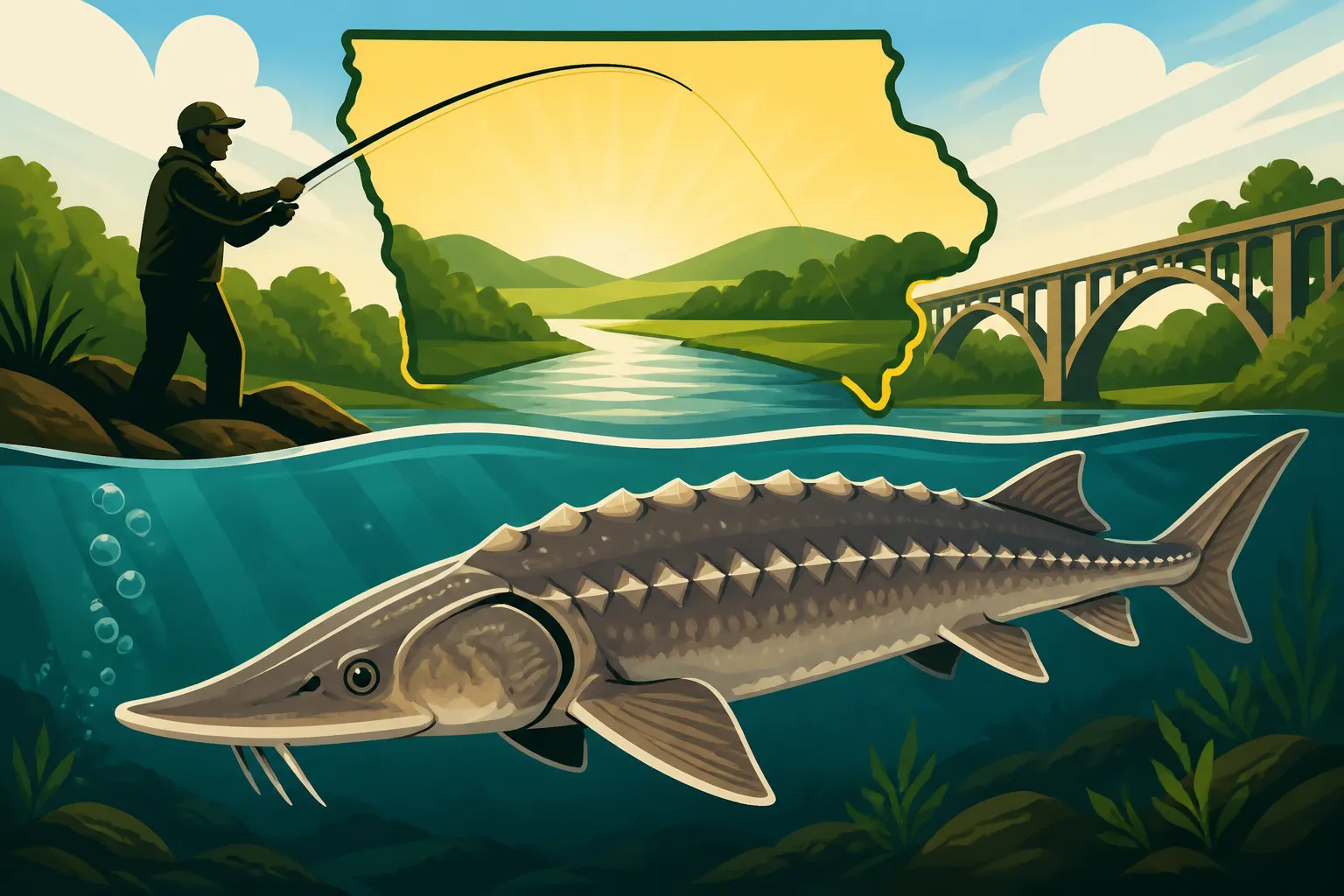
In contrast to their protected relatives, the shovelnose sturgeon is a more common sight in Iowa's larger rivers. These aren't the behemoths of the sturgeon world, but they're still robust and fascinating fish that offer a unique angling experience. They're characterized by their distinctive shovel-shaped snout (hence the name!) and their rough, armor-plated bodies. Unlike lake sturgeon, there are specific regulations that allow for the legal harvest of shovelnose sturgeon in certain areas, particularly on border rivers. This means that, with proper identification and adherence to local rules, you can actually target and keep shovelnose sturgeon. Understanding where and how to identify these fish correctly is the first step toward a successful and legal fishing trip. The differences, while subtle to an untrained eye, are absolutely critical to know.
Identifying the Shovelnose Sturgeon
Accurately identifying a shovelnose sturgeon is paramount for any Iowa angler. Mistakes can lead to significant penalties, especially if you accidentally keep a protected lake sturgeon. Thankfully, once you know what to look for, distinguishing the shovelnose from other sturgeon species becomes much clearer. It’s all in the details, and paying close attention can save you a lot of headache.
Distinctive Physical Characteristics
The shovelnose sturgeon ( Scaphirhynchus platorynchus ) is truly a marvel to behold, with several key features that set it apart. First and foremost, as its name suggests, is its flattened, shovel-like snout. This broad, duckbill-like nose is very pronounced. Their bodies are covered in five rows of bony plates, called scutes, which run along their back and sides, giving them a very prehistoric, armored appearance. Look closely at the belly; a key identifier for the shovelnose sturgeon is its fully plated belly. This means the area between the anus and the anal fin is covered in bony plates, not smooth skin. Their tail fin is also distinctive, with the upper lobe being noticeably longer than the lower lobe, ending in a filament-like extension in many individuals. Typically, they are much smaller than lake sturgeon, usually topping out around 30 inches in length and weighing a few pounds, though larger specimens are certainly caught. The overall color tends to be a sandy brown or olive on top, fading to a lighter, often white or yellowish belly. You can often find detailed fish identification guides, sometimes available through outdoor retailers like Amazon, which can be invaluable for cross-referencing these features right on the riverbank.
These fish also have four barbels—fleshy, whisker-like sensory organs—hanging in front of their mouth, which they use to forage for food along the river bottom. These barbels are typically fringed and are all roughly the same length. The mouth itself is small and protrusible, designed for sucking up small invertebrates from the substrate, not for biting or tearing. When you pull one of these fish from the water, take a moment to really observe these features before deciding if it's a keeper or needs to go back. Always handle them carefully, especially if you're planning to release them, to minimize stress and injury.
Key Differences from Lake Sturgeon
Distinguishing a shovelnose sturgeon from a lake sturgeon (Acipenser fulvescens) is the most crucial identification challenge for Iowa anglers. While both are sturgeon, their appearance and legal status are quite different. The most reliable physical indicator lies in their bellies: the shovelnose sturgeon has a fully plated belly between the anus and anal fin, while the lake sturgeon has a smooth, unplated belly in that same area. This is the single most important diagnostic feature to remember.
Another significant difference is the snout shape. The shovelnose sturgeon, as we discussed, has that distinctive flat, broad, shovel-like snout. The lake sturgeon, conversely, has a more conical or rounded snout. While both have barbels, the shovelnose's barbels are usually fringed and positioned closer to the mouth, all being roughly the same length. Lake sturgeon barbels are smooth and typically not uniform in length, with the inner two being longer than the outer two. Size is also a major clue: lake sturgeon are generally much larger, growing to lengths well over 50 inches and weighing many tens of pounds, whereas shovelnose sturgeon rarely exceed 3 feet and are typically under 10 pounds. If you catch a large sturgeon, err on the side of caution and assume it's a protected lake sturgeon. Remember, Sturgeon Fishing Rules on Iowa Waters are very specific, and a mistaken identity could lead to serious consequences. When in doubt, let it swim!
Shovelnose Sturgeon Habitat and Behavior in Iowa Rivers
Understanding where shovelnose sturgeon prefer to live and how they behave can greatly improve your chances of finding them and appreciating their role in Iowa's aquatic ecosystems. These fish are true river dwellers, perfectly adapted to the dynamic environments of large flowing waters. They are not just randomly distributed; they seek out specific conditions that meet their needs for feeding, protection, and spawning.
Preferred Riverine Environments
Shovelnose sturgeon are predominantly found in the larger, turbid rivers of Iowa, particularly the Mississippi, Missouri, and Des Moines rivers. They thrive in strong currents and prefer areas with sand and gravel bottoms. You'll often find them in main channel areas, near wing dams, sand bars, and in the scour holes created by the river's flow. These areas provide the necessary substrate for their foraging habits and offer a constant supply of food moving with the current. Unlike many fish that seek out still water or deep pools exclusively, shovelnose sturgeon are built for the flow, using their streamlined bodies and stiff fins to hold their position against the powerful river. Fishing the Mississippi River in Iowa is a prime example of where you can consistently find these unique fish.
They tend to avoid heavily vegetated or stagnant backwater areas. Instead, look for them where the river bottom is swept clean by the current, exposing sand, gravel, and small rocks. Depths can vary, but they are often found in moderate depths, not necessarily the deepest holes, but where there's enough current to bring them a steady stream of food. On the Mississippi River, specific structures like wing dams are particularly productive, as these create current breaks and eddies where food collects, making them attractive feeding grounds for shovelnose sturgeon. You'll find similar hotspots in Fishing the Des Moines River in Iowa and Fishing the Missouri River Border, especially in stretches with strong, consistent current.
Diet and Feeding Habits
Shovelnose sturgeon are bottom feeders, pure and simple. Their small, protrusible mouths and sensitive barbels are perfectly designed for rooting around in the riverbed. Their diet consists primarily of aquatic insects and their larvae, small crustaceans, and other invertebrates. They're not chasing down schools of baitfish; instead, they're sifting through the bottom sediments, using their barbels to detect morsels of food. This makes them relatively easy to target with the right bait, as they are not overly picky about the type of invertebrate.
You can think of them as the river's vacuum cleaners, constantly working the bottom to find their next meal. This behavior means that presentations that keep your bait on or near the bottom will be the most effective. They are opportunistic feeders, so whatever small, squishy, or buggy bits are available in the substrate are fair game. This consistent feeding habit makes them a reliable target for anglers who understand their ecological niche. For anglers, this translates into using baits that mimic these natural food sources, or at least present an appealing scent profile down current.
Spawning and Life Cycle
Shovelnose sturgeon have a fascinating life cycle adapted to their riverine environment. Spawning typically occurs in late spring or early summer, when water temperatures rise to suitable levels, usually between 60-70 degrees Fahrenheit. They migrate upstream to specific spawning grounds, often over gravel or rock riffles and shoals where the current is strong. The females release their eggs, which are then fertilized by the males. The eggs are adhesive and stick to the substrate, developing quickly into larvae.
Once hatched, the larval sturgeon drift downstream, often hiding in the interstitial spaces of gravel to avoid predation. As they grow, they develop the distinctive scutes and shovel snout, eventually adopting the bottom-dwelling lifestyle of the adults. Shovelnose sturgeon are relatively long-lived, often reaching 10-20 years of age, though not nearly as long as their lake sturgeon cousins. Their reproductive success is highly dependent on healthy river systems with appropriate spawning habitats and unobstructed migration routes. Understanding this life cycle reinforces the importance of responsible angling and conservation efforts, especially when considering Shovelnose Sturgeon Season and Limits which are set to protect these crucial periods.
Fishing for Shovelnose Sturgeon in Iowa
Fishing for shovelnose sturgeon can be a rewarding experience, offering a unique challenge and the chance to connect with a truly ancient fish. However, it's not as simple as just dropping a line; you need to be aware of the specific rules and techniques that apply to these interesting creatures. Ignoring the regulations could turn a fun day into a frustrating one, so let's make sure you're well-informed.
Legal Considerations and Regulations
Before you even think about targeting shovelnose sturgeon, you must know the current regulations. In Iowa, shovelnose sturgeon are not federally protected like lake sturgeon, but they are subject to state and sometimes specific border water regulations. Generally, on the Mississippi River, which forms Iowa's eastern border, shovelnose sturgeon can be harvested with specific length and bag limits. These limits can vary, so always consult the latest Iowa fishing regulations booklet or website before your trip. For example, there might be a minimum length requirement or a daily bag limit for how many you can keep. On other Iowa rivers, such as the Des Moines River, regulations might be different, sometimes even requiring immediate release.
The most critical part of the regulation is identification. If you accidentally catch a lake sturgeon while targeting shovelnose, you must release it immediately, without taking it out of the water if possible, to minimize stress. Failure to do so can result in hefty fines. It's a good idea to have a measuring tape handy and to quickly identify your catch. Knowing the rules in advance, especially concerning Shovelnose Sturgeon Season and Limits, will make your fishing experience much more enjoyable and compliant.
Effective Techniques and Bait
Fishing for shovelnose sturgeon isn't overly complicated, but it does require some specific approaches due to their bottom-feeding nature and preferred habitat. The most effective technique is bottom fishing in areas with current, such as those near wing dams, sand flats, or channel edges. A simple Carolina rig or a three-way swivel rig works wonders. For the Carolina rig, you'll need an egg sinker (1-3 ounces depending on current) above a swivel, with a 12-24 inch leader ending in a hook. For the three-way swivel, tie your main line to one eye, a sinker (often a pyramid or bell sinker) to another, and a leader with your hook to the third. The key is to keep your bait on the bottom, where these fish are foraging. Many anglers use heavy enough tackle to withstand the river current and potential snags. While you might use a similar setup for catfish, remember that sturgeon mouths are smaller, so hook size should be appropriate. You can often find durable, cost-effective gear for this type of fishing on Amazon, including weights and hooks.
When it comes to bait, shovelnose sturgeon are not particularly finicky. They are scavengers and insect eaters. Cut bait, worms (nightcrawlers are excellent), and shrimp are all highly effective. Some anglers even use commercially prepared stink baits, though natural baits are generally preferred. The goal is to provide a scent trail that attracts them as they nose along the bottom. Cast your rig upstream and let it drift downstream, or cast directly into current breaks and let it settle. Patience is key, as sturgeon bites can sometimes be subtle, a gentle tug rather than a sharp strike. Given the strength of river currents, a sturdy rod, similar to what you might use for catfish, is recommended. Consider looking for a good Best Rod for Catfish Fishing to double for shovelnose sturgeon.
Best River Systems for Shovelnose Sturgeon
If you're looking to target shovelnose sturgeon in Iowa, you'll want to focus your efforts on the larger river systems that feed into or are part of the Mississippi River basin. These are the fish's natural strongholds.
The Mississippi River is undoubtedly the premier location for shovelnose sturgeon fishing in Iowa. Throughout its entire stretch bordering Iowa, from Pool 9 in the north to the confluence with the Missouri River further south, you'll find healthy populations. Specific areas like Mississippi River Pool 9 Fishing, Mississippi River Pool 10 Fishing, and Mississippi River Pool 12 Fishing are well-known for producing good numbers of these fish. Look for areas around wing dams, rip-rap shorelines, and main channel borders where the current is strong and the bottom is sandy or gravelly. Boating access allows for more flexibility in reaching prime spots, but many successful anglers also fish from accessible shorelines near public boat ramps or parks.
Beyond the Mississippi, the Missouri River (which forms Iowa's western border) also hosts a robust population of shovelnose sturgeon. The conditions here are similar – strong currents, vast sandy or gravelly bottoms, and abundant invertebrate life. Fishing the Missouri River presents its own challenges with powerful currents and shifting sandbars, but the rewards can be great. Fishing the Missouri River Border offers excellent opportunities.
Finally, some of the larger interior rivers, particularly the lower stretches of the Des Moines River as it approaches the Mississippi, can also produce shovelnose sturgeon. While not as prolific as the border rivers, these sections offer more localized opportunities. When planning your trip, always check the specific regulations for the river segment you intend to fish, as rules can sometimes differ from the border waters. The key to success on any of these rivers is understanding the current and knowing how to effectively present your bait on the bottom.
Conservation and Management Efforts
As anglers, we have a responsibility to not just enjoy our natural resources, but also to protect them for future generations. Shovelnose sturgeon, while not as critically endangered as their lake sturgeon relatives, still benefit greatly from thoughtful management and ethical angling practices. Their continued presence in Iowa's rivers is a testament to the health of those ecosystems, and we all play a part in keeping them thriving.
Importance of Responsible Angling
Responsible angling for shovelnose sturgeon begins with strict adherence to all regulations. This means knowing your Iowa Fishing Regulations Explained inside and out, especially bag and size limits for shovelnose sturgeon, and the absolute necessity of releasing any accidentally caught lake sturgeon immediately and unharmed. Carry a tape measure and, if needed, a camera to quickly document your catch if you're unsure, but prioritizing the fish's health for release is always paramount. Minimizing handling time, supporting the fish horizontally, and using appropriate unhooking tools (like needle-nose pliers) are crucial for catch-and-release success. Even if you plan to keep a legal shovelnose, understanding how to dispatch it quickly and humanely is part of ethical angling.
Another aspect of responsible angling involves protecting the habitat. Avoid littering, respect private property, and be mindful of your impact on the river environment. If you're using a boat, practice safe boating and be aware of spawning areas if they are publicly known. By practicing catch and release for fish you don't intend to keep or that are undersized, and by respecting the environment, we ensure that these unique fish continue to enrich Iowa's rivers. If you ever witness a violation, like someone keeping a protected species or exceeding limits, know How to Report a Fishing Violation in Iowa to help protect the resource.
Monitoring and Population Health
The Iowa Department of Natural Resources (DNR) and other state agencies actively monitor shovelnose sturgeon populations through surveys and research. This ongoing monitoring helps biologists understand population trends, health, and reproductive success. Data collected from these studies is crucial for setting effective fishing regulations, such as bag limits and length restrictions, to ensure sustainable harvest and protect the species from overfishing. They analyze factors like water quality, habitat availability, and spawning success to get a comprehensive picture of the species' well-being.
Research also contributes to our understanding of the broader river ecosystem. Since shovelnose sturgeon are long-lived and occupy a specific niche, their health can often be an indicator of the overall health of the large river systems they inhabit. Conservation efforts might include habitat restoration projects, such as ensuring access to spawning grounds or managing river flow to benefit sturgeon populations. By supporting these efforts through license purchases and adherence to regulations, anglers directly contribute to the long-term health of shovelnose sturgeon and the rivers they call home. It's a continuous cycle of enjoying, learning, and protecting.
| Feature | Shovelnose Sturgeon | Lake Sturgeon (Protected in Iowa) |
|---|---|---|
| Snout Shape | Flat, broad, shovel-like | More conical or rounded |
| Belly Plating | Fully plated between anus and anal fin | Smooth, unplated belly between anus and anal fin |
| Barbels | Fringed, all roughly same length, closer to mouth | Smooth, inner two longer than outer two, further from mouth |
| Size | Typically 18-30 inches, rarely over 3 feet | Can reach over 50 inches, much larger and heavier |
| Tail Fin | Upper lobe longer, often with a filament | More rounded lobes, usually without a long filament |
| Legal Status in Iowa | Harvest allowed with specific regulations | Strictly Protected, Catch and Release ONLY |
| Typical Habitat | Strong currents, sand/gravel bottoms in large rivers | Lakes and large rivers, sometimes moving to tributaries for spawning |
Disclaimer
This article is for general informational purposes only and does not constitute professional advice. Laws, prices and regulations vary by location and change over time. Consult a qualified professional for guidance on your specific situation.