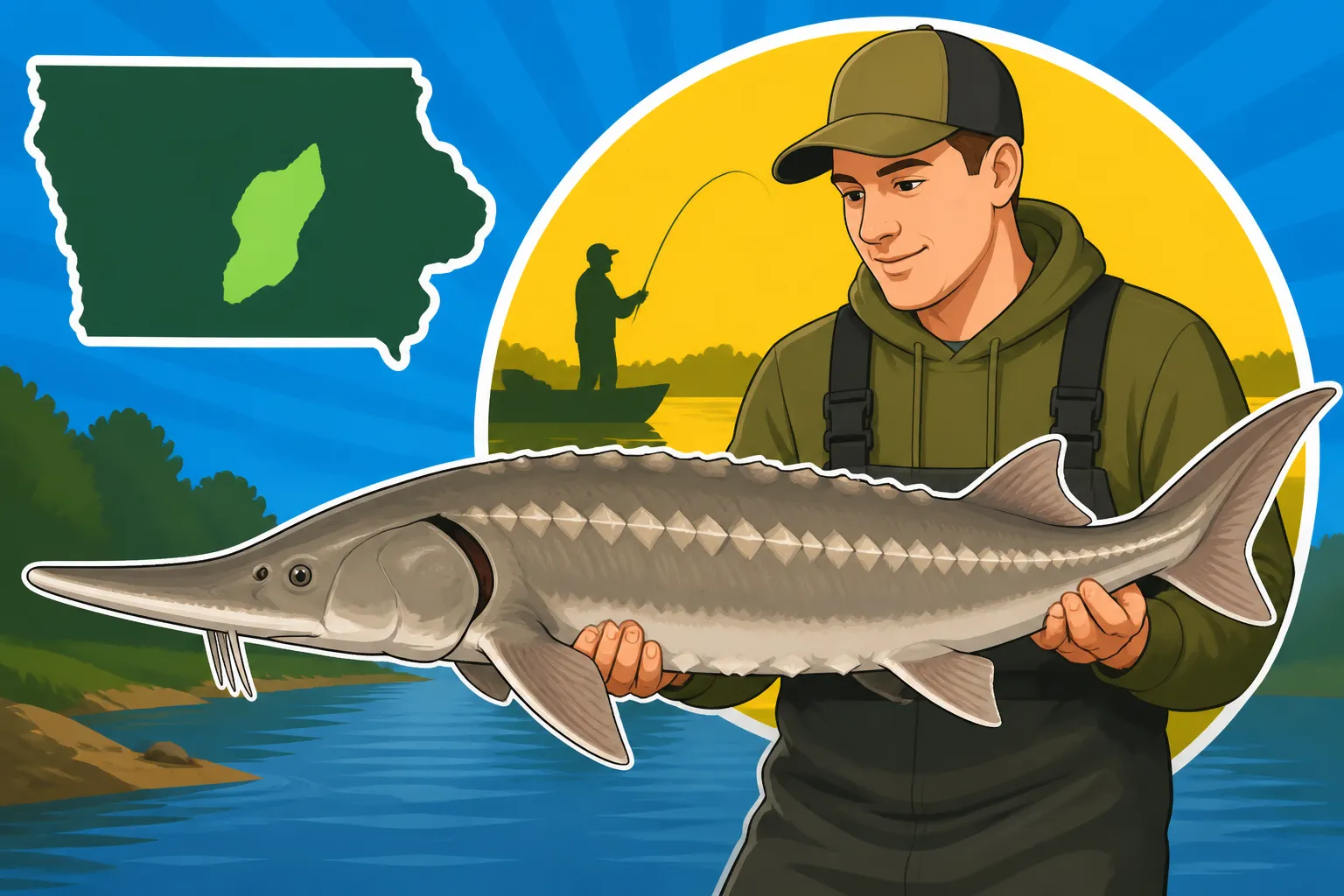
How Old a Shovelnose Sturgeon That Size Is
It's incredibly exciting to reel in a magnificent shovelnose sturgeon from one of Iowa's grand rivers, isn't it? As anglers, our minds naturally race with questions when we land a truly impressive specimen – "How old is this fish? What has it seen?" But trying to pinpoint the exact age of a shovelnose sturgeon based solely on its size, especially a significant one, can feel like trying to guess a person's age just by their height. This guide is here to unravel the mysteries behind shovelnose sturgeon growth, helping you understand the many variables that influence their size and what that might mean for their longevity in Iowa's waterways.
Understanding Shovelnose Sturgeon Growth in Iowa Waters
Shovelnose sturgeon are truly ancient fish, and their life cycles are quite different from the more common game species we often pursue in Iowa. They're built for survival in powerful river systems, and their growth rate reflects a long-term strategy rather than a rapid sprint. This means that while a big fish is certainly old, putting an exact number on it just from its length or weight is trickier than you might think.
General Growth Rates and Lifespans
Generally speaking, shovelnose sturgeon are relatively slow-growing fish. They mature later in life compared to, say, a channel catfish, and they can live for a surprisingly long time. We're talking decades, not just a few years. In the Mississippi and Missouri River systems that border or flow through Iowa, these fish are constantly navigating dynamic environments, which affects everything from their feeding opportunities to their energy expenditure. A young shovelnose sturgeon might only grow a few inches a year, especially in its early life. As it gets older and larger, that growth might slow down even further, becoming more about maintaining its robust size than adding significant length.
Think about it this way: a human teenager might shoot up several inches in a single year, but an adult in their 30s or 40s won't experience that kind of rapid change. Sturgeon are similar in that their most significant growth spurts happen earlier in life, but even then, it's a gradual process. They’re not designed for fast food, quick growth, and short lives; they're built for endurance.
Habitat Impact on Development
The specific stretch of river a shovelnose sturgeon calls home plays a massive role in its development. A sturgeon living in a nutrient-rich section of the Mississippi River with ample forage and stable conditions might grow faster and larger than one in a less productive stretch. River currents, water temperature fluctuations, and even the type of substrate (sandy, rocky, muddy) all contribute to the overall health and growth potential of the fish. These are bottom-feeders, after all, and their ability to root out insect larvae, worms, and small crustaceans directly impacts how much energy they have for growth.
Consider a shovelnose sturgeon in a section of the river where dredging or habitat alterations are common; such disruptions could limit their feeding grounds, forcing them to expend more energy searching for food, which in turn could slow down their growth significantly. On the flip side, areas with stable, diverse macroinvertebrate populations provide a consistent buffet, allowing the fish to thrive and grow larger over time. Understanding Shovelnose Sturgeon in Iowa Rivers gives you a better idea of their preferred haunts.
Factors Influencing Sturgeon Size and Age
When you're trying to figure out how old a specific shovelnose sturgeon might be, there's a whole cocktail of biological and environmental factors at play. It's never as simple as "X inches equals Y years."
Environmental Conditions: Temperature and Food Availability
Water temperature is a huge one. Sturgeon, like all cold-blooded fish, have their metabolism directly tied to the water temperature. In warmer years or warmer stretches of the river, they might be more active, feed more frequently, and grow a bit faster. Conversely, prolonged periods of cold water can slow their metabolism, reducing their feeding activity and thus their growth. It's a delicate balance that shifts with the seasons and yearly climate patterns.
Food availability is perhaps the most critical factor. Shovelnose sturgeon are opportunistic bottom feeders. If their preferred food sources—things like insect larvae, crayfish, and small fish—are abundant, they'll have more energy to convert into growth. If food is scarce, due to environmental changes, competition, or population booms of other species, their growth can be stunted. Imagine a year with a massive hatch of aquatic insects; that could be a boom time for young sturgeon putting on size. A year with low water levels and reduced habitat for invertebrates? That's going to be a tougher year for growth. This is why a 25-inch shovelnose sturgeon from one part of the river might be a different age than a 25-inch fish from another, less productive area.
Genetic Predisposition and Individual Variation
Just like people, fish have individual genetics that influence their potential size and growth rate. Some sturgeon might simply be genetically programmed to grow larger or faster than others, even when raised in identical conditions. You might have one fish that hits 30 inches at a relatively younger age, while another of the same age from the same spawn might only be 25 inches, purely due to genetic lottery. This natural variation is part of the beauty of wildlife, but it makes precise age estimation from size alone a guessing game.
Beyond genetics, individual sturgeon will have different life experiences. One might have survived a tough winter in its youth, limiting its early growth, while another might have found an optimal feeding ground and avoided predators, allowing it to flourish. These subtle differences accumulate over decades, making each large sturgeon a unique story. If you're pondering Sturgeon Fishing Rules on Iowa Waters, remember these fish have a long history.
Population Density and Competition
Another significant factor is the density of the sturgeon population itself. If there are a lot of shovelnose sturgeon (or other competing bottom feeders) in a particular area, competition for food can become intense. This competition can limit the resources available for each individual fish, leading to slower growth rates across the population. Conversely, in areas with lower population density and abundant food, individual fish might grow larger and faster simply because there's more to go around.
This competition isn't just with other sturgeon. Other species, like carp or even large schools of panfish, can also impact the availability of the benthic invertebrates that sturgeon rely on. It’s a complex river ecosystem, and the growth of one species is often intertwined with the health and abundance of many others. Anglers who keep up with Iowa Fishing Regulations Explained can play a part in sustainable populations.
Here's a quick look at how various factors play a role:
| Factor | Impact on Sturgeon Growth | Example Scenario |
|---|---|---|
| Water Temperature | Warmer water can increase metabolism and feeding; colder water slows it down. | A sturgeon in a perpetually cooler northern river section might grow slower than one in a warmer southern stretch. |
| Food Availability | Abundant food (invertebrates, small fish) leads to faster growth; scarcity leads to slower growth. | A river section with rich mussel beds and insect hatches will produce larger sturgeon. |
| Genetic Potential | Individual genetic makeup determines maximum growth potential and rate. | Some sturgeon are simply "big genes" fish, destined to be larger than average. |
| Population Density | High density increases competition for food, potentially stunting growth. | A crowded backwater with many bottom feeders might have smaller, older sturgeon. |
| Habitat Quality | Access to optimal feeding grounds, cover, and stable conditions enhances growth. | A stretch of river with undisturbed sandy/gravel bars for foraging encourages better growth. |
| Fishing Pressure | While not directly impacting individual growth, heavy harvest can remove larger, older fish. | If anglers frequently keep fish above a certain size, fewer trophy-sized, truly ancient fish will be found. |
Estimating Age from Size: The Challenges and Nuances
So, you've caught a substantial shovelnose sturgeon, say a 30-inch behemoth. What's its age? The truth is, without scientific methods, it's very difficult to know for sure. While we can make educated guesses, the factors discussed above mean that a precise age cannot be determined by size alone.
Why "That Size" Isn't a Direct Age Indicator
The biggest challenge is that growth rates are not constant or uniform across all individuals or environments. A 30-inch shovelnose sturgeon could be anywhere from 15 to 30 years old, or even older, depending on its specific life history. One fish might hit 30 inches in 18 years due to ideal conditions, while another in a tougher environment might take 25 years or more to reach the same length. This is particularly true for older, larger fish, where growth slows dramatically.
It's tempting to think of fish growth like a tree's rings, where each ring clearly marks a year. But with fish, especially those with indeterminate growth like sturgeon, the "rings" are influenced by so many external factors that a wide band doesn't always mean a "good" year, and a narrow band doesn't always mean a "bad" year. It's all relative to the individual fish and its unique journey.
Scientific Methods for Aging Sturgeon
When fisheries biologists need to know the age of a sturgeon, they don't just measure it. They use specialized techniques:
- Fin Ray Sections: This is the most common method. Biologists remove a small, non-lethal cross-section of one of the pectoral fin rays (a bony support structure in the fin). When cut and polished, these sections reveal annual growth rings, much like tree rings. These rings are called annuli, and they form as bone is added each year. Counting these annuli gives a relatively accurate age for the fish.
- Scute Sections: Sturgeon also have bony plates called scutes along their bodies. In some cases, sections of these scutes can also be used to count growth rings.
- Otoliths (Ear Bones): While common for aging many fish species, sturgeon otoliths are very small and not typically used for age determination compared to their fin rays.
These methods require specialized equipment and training, making them impractical for the average angler. So, while you might be curious about the exact age of that impressive fish you caught, remember that even a small, non-lethal sample needs to be taken responsibly, and often requires specific permits or professional intervention. When buying gear for responsible catch and release, you might find useful resources like measuring tapes and cameras on Amazon to record your catch without harm.
What an Angler Can Estimate and Observe
As an angler, you can certainly appreciate the size and condition of the sturgeon you catch. A very large, robust shovelnose sturgeon with a deep body and strong features is undoubtedly an old fish. It has survived many seasons, many floods, and many challenges in the river. That alone is a testament to its resilience.
You can also observe general patterns. Smaller shovelnose sturgeon, perhaps under 20 inches, are generally younger, likely in their first decade of life. Fish in the 20-30 inch range are adults, typically ranging from a decade to several decades old. Any shovelnose sturgeon exceeding 30 inches is a true veteran of the river, likely having lived for 20, 30, or even 40 years or more. These are the giants, the survivors, the ones that have truly beaten the odds. If you're thinking of targeting these magnificent creatures, consider investing in a high-quality reel found on Amazon to handle their power.
Conservation and Management of Shovelnose Sturgeon in Iowa
Understanding the age and growth of shovelnose sturgeon isn't just about satisfying curiosity; it's vital for their conservation. These fish face various threats, and robust management practices are essential to ensure their populations thrive for future generations of Iowa anglers.
The Importance of Protecting Older, Larger Fish
Older, larger shovelnose sturgeon are incredibly important for the health of the population. They are often the most reproductively successful, contributing significantly to the next generation of fish. Removing too many of these trophy-sized individuals can have a detrimental effect on the species' ability to replenish itself. This is why strict regulations, including size and bag limits, are often put in place, and why catch-and-release is so highly encouraged for these unique fish. Learning about Shovelnose Sturgeon Season and Limits is crucial for any responsible angler.
These big fish are also invaluable indicators of river health. Their presence, and their ability to reach such venerable ages, speaks volumes about the quality of the habitat, the abundance of food, and the overall ecological balance of the waterway.
Shovelnose Sturgeon Regulations in Iowa
Iowa has specific regulations in place to protect shovelnose sturgeon, particularly because they can be easily confused with the endangered pallid sturgeon, which lives in similar habitats. Anglers need to be incredibly careful when identifying their catch. Typically, shovelnose sturgeon have a distinct filament on their tail fin, which pallid sturgeon lack, but other features are also critical for identification. Fishing for sturgeon can be a unique experience, and having the right identification guide, perhaps one you found on Amazon, can prevent you from accidentally harming a protected species.
Make sure you are always up-to-date on the current Iowa Fishing Regulations Explained before heading out. Violating these rules, especially concerning protected species like the pallid sturgeon, can lead to significant penalties. Anglers are often required to immediately release any sturgeon they cannot positively identify as a shovelnose, or any that exceed or fall below specific size limits for shovelnose sturgeon.
How Anglers Contribute to Conservation
Every angler plays a critical role in the conservation of shovelnose sturgeon. By understanding and adhering to regulations, practicing careful catch-and-release, and accurately reporting catches (when required), we help biologists gather data and manage these populations effectively. Being able to identify a shovelnose sturgeon confidently from its protected cousins is a skill every river angler should cultivate. Carrying a proper fish measuring tool is also essential, and many reliable options can be found on Amazon.
Remember, the thrill of catching a shovelnose sturgeon, especially a truly old, large one, comes with the responsibility of ensuring its continued survival. Releasing these magnificent, long-lived fish unharmed allows them to continue their journey in Iowa’s rivers, contributing to the health of the ecosystem and offering future generations the same chance to marvel at these living fossils.
Disclaimer
This article is for general informational purposes only and does not constitute professional advice. Laws, prices and regulations vary by location and change over time. Consult a qualified professional for guidance on your specific situation.