Best Ice Thickness for Safe Ice Fishing
There's nothing quite like the crisp air, the quiet solitude, and the thrill of pulling a fish through a tiny hole in the ice. But let's be real, the thought of cracking through that frozen surface is a fear that looms large for every ice angler. Understanding the dangers of thin ice and precisely how thick it needs to be for your chosen activity is absolutely critical for a safe and enjoyable outing, and this guide is here to clear up all that uncertainty.
The Golden Rule: Minimum Ice Thickness for Safe Passage
When you're looking out at a frozen Iowa lake or pond, it can be deceptively inviting. But looks can be deceiving, and what seems solid can actually be quite fragile. The Iowa Department of Natural Resources (DNR) has some very clear, common-sense guidelines that we all need to stick to. These aren't just suggestions; they're the difference between a great day of fishing and a terrifying, potentially deadly, accident. It's about respecting nature and keeping ourselves and our loved ones safe out there.
Walking, Fishing, and Light Activities
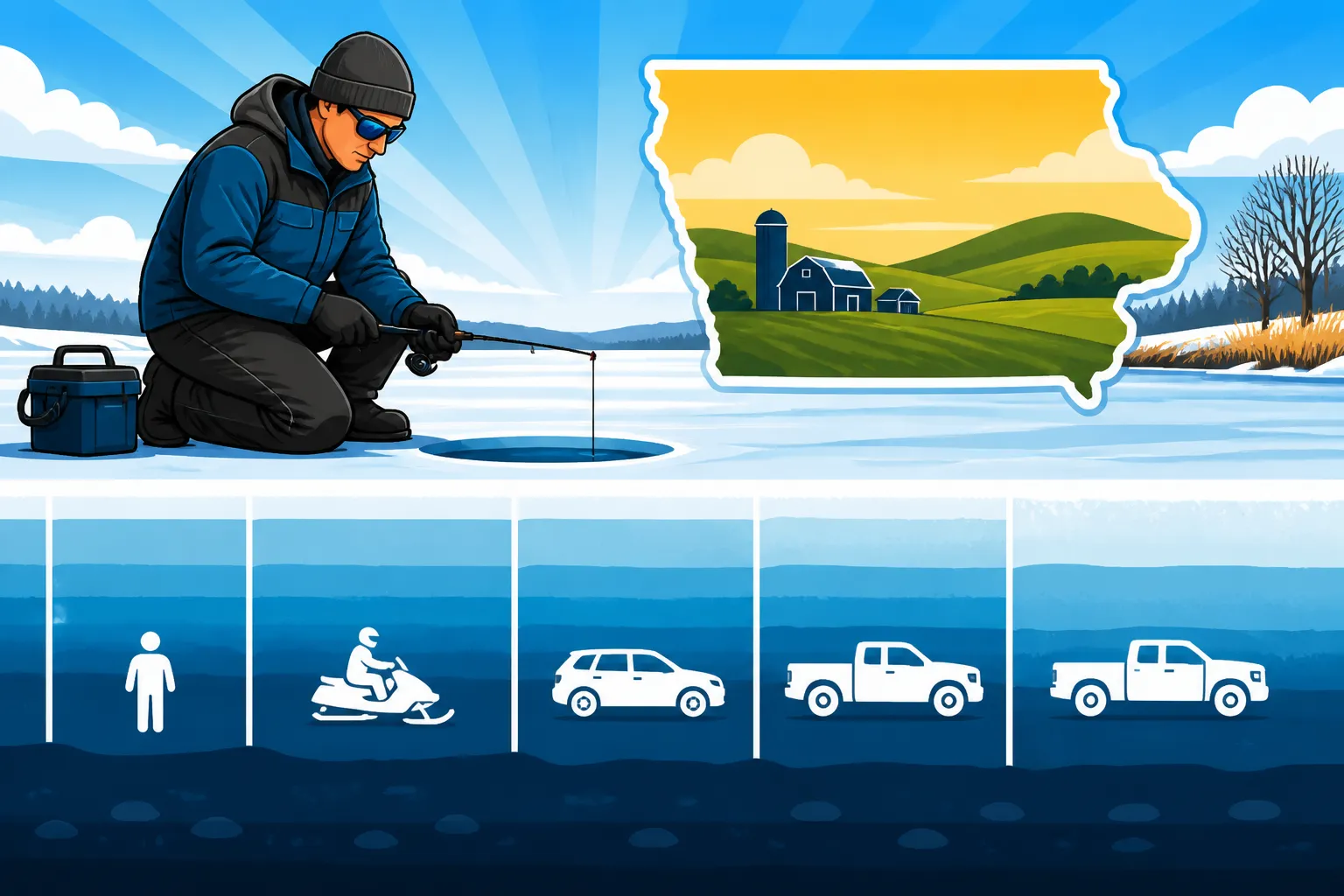
For simply walking onto the ice and setting up your gear for a day of fishing, you absolutely need at least 4 inches of clear, solid ice. This is the absolute minimum, your starting point, your non-negotiable threshold. Think of it this way: if you're a solo angler, heading out with just your auger, a bucket, and a couple of rods, four inches might hold you. But what if you slip? What if the ice quality isn't uniform? What if there's an unseen spring below? That 4-inch mark is a bare minimum, and honestly, if it's only 4 inches, you should be moving with extreme caution, constantly checking, and maybe even fishing closer to shore.
When you're bringing out your ice fishing shelter, a propane heater, and all the tackle that comes with a comfortable setup, you're adding significant weight. While 4 inches might technically hold one person, it quickly becomes precarious with extra gear. This is where the buddy system really shines, and also where you might want to consider waiting for a bit more ice. Remember, clear, black ice is generally the strongest, while milky or snow-covered ice can be much weaker. Always err on the side of caution. If you're unsure how to tell the difference, it’s best to wait for a thicker, more consistent freeze.
Snowmobiles and ATVs
Now, if you're planning to zip across the frozen expanse on a snowmobile or an ATV to reach those prime fishing spots, you'll need significantly more ice. For snowmobiles, the recommendation is typically 5 to 7 inches of solid ice, and for ATVs, you're looking at 7 to 8 inches. This increase in required thickness is all about weight distribution. A snowmobile or ATV concentrates a lot of weight in a smaller footprint compared to a person on foot, and the speed at which you travel can also create dynamic stress on the ice.
Imagine you and a few friends are planning a trip to a secluded cove on West Okoboji Lake for some walleye fishing. You've loaded up your ATVs with gear, portable shacks, and coolers. While the main body of the lake might have 8 inches of ice, what about the path you're taking, especially near shore or over potential pressure ridges? You need to be vigilant. Always check ice thickness frequently, even if you’ve traveled that route before. A spud bar is your best friend when on an ATV or snowmobile, allowing you to probe the ice ahead of you. Riding in a group is smart, but leaving plenty of space between vehicles is even smarter, preventing too much weight from accumulating in one area. If you're interested in more details on safe practices, our guide on Ice Fishing Safety on Iowa Lakes offers excellent advice.
Small Cars and Light Trucks
Driving a vehicle onto the ice is a whole different ballgame and carries the highest risk. Many veteran anglers do it, especially on larger, well-established ice fishing destinations like Clear Lake or Spirit Lake, but it requires extreme caution and a deep understanding of ice conditions. For a small car, you’re looking at 8 to 12 inches of solid ice, and for a light truck, it’s 12 to 15 inches or more. This isn't a recommendation to just go for it; it's the absolute minimum for those who choose to take the risk.
Consider an angler with a pickup truck, loaded with a large, permanent ice shack and all the comforts of home, heading out onto a broad lake. Even with sufficient ice, you need to be aware of the vehicle's weight, including passengers and gear. Drive slowly, keep windows down, and have an escape plan ready. It's also vital to leave plenty of space between vehicles. Parking too close to other vehicles or fishing shacks can concentrate weight, creating weak points. Before even thinking about driving on, confirm with local bait shops or DNR reports about current conditions, as these conditions can change rapidly. For those contemplating this, our guide on Best Ice Thickness for Safe Ice Fishing (this is the current article, so I'll link to another relevant one) – maybe When Ice Fishing Season Typically Starts in Iowa – can provide additional context on how conditions develop.
Here's a handy table summarizing these general guidelines:
| Activity / Vehicle Type | Minimum Safe Ice Thickness (Clear, Solid Ice) | Notes |
|---|---|---|
| Foot Travel (single angler) | 4 inches | Absolute minimum. Proceed with extreme caution. Check frequently. |
| Groups of people | 5-6 inches | Spread out; do not congregate. Ideal for portable shelters and gear. |
| Snowmobiles | 5-7 inches | Drive slowly. Maintain distance from others. |
| ATVs / UTVs | 7-8 inches | Drive slowly. Maintain distance from others. |
| Small Cars | 8-12 inches | Use extreme caution. Check local reports. Avoid driving over cracks or pressure ridges. |
| Light Trucks | 12-15+ inches | Highest risk. Only for experienced ice anglers after thorough verification of conditions. Drive slow. |
Factors That Undermine Ice Strength, Even When It Looks Thick
It's not just about the number on your tape measure; it's about the quality of the ice. A seemingly thick sheet of ice can be dangerously weak if other environmental factors are at play. This is where experience and a healthy dose of skepticism really come in handy, especially when you're exploring new waters or after a tricky weather pattern. Don't let appearances fool you!
Weather Fluctuations and Snow Cover
Iowa winters can be notoriously fickle, offering up bone-chilling cold one day and surprisingly mild temperatures the next. These fluctuations play a massive role in ice integrity. A solid week of sub-zero temperatures will create strong, clear ice, but even a couple of days of above-freezing temperatures, especially combined with bright sunshine, can rapidly degrade the top layers of ice. This can create a weak, honeycombed structure, even if the overall thickness still measures well. It's why many anglers prefer going out when How Cold Iowa Gets During Ice Fishing Season is consistently low.
Snow cover is another major factor. While a fresh blanket of snow might look picturesque, it acts as an insulator, preventing the ice underneath from thickening further. More importantly, heavy snow can trap water on top of the ice, creating slush. This slush eventually freezes, but it forms "snow ice" or "white ice," which is significantly weaker and less dense than the clear, "black ice" that forms directly from freezing water. Imagine trying to walk on frozen foam compared to a solid block of ice – that's the difference. Always probe through snow cover to check the actual ice underneath. For deeper dives into weather-related techniques, our guide on Ice Fishing in Iowa covers this extensively.
Water Currents, Springs, and Structures
Not all parts of a frozen body of water freeze uniformly, and certain features will always be notorious weak spots. Rivers, for instance, are rarely safe for ice fishing unless they are completely stagnant or in areas of very slow flow. The continuous movement of water prevents stable ice formation. Even on lakes, you need to be wary of inlets (where streams or rivers flow in), outlets (where water flows out), and underwater springs. These areas introduce warmer, moving water that can create dangerously thin ice, even if the surrounding lake is perfectly solid.
Man-made structures like bridge pilings, docks, and submerged cribs can also absorb heat or alter currents, leading to thinner ice around them. Always maintain a wide berth around these features. For example, if you're fishing near a known channel on the Mississippi River, even if it appears frozen, the currents running underneath can make the ice incredibly unpredictable. Similarly, certain areas of larger lakes, like the Iowa Great Lakes, might have distinct currents or depths that affect ice formation. Always scout ahead, and if you see open water near a seemingly frozen area, it’s a huge red flag to stay away.
"New" Ice vs. "Old" Ice
Not all ice is created equal. The strongest and safest ice is typically "new ice" that has formed rapidly during a period of sustained cold. This ice is usually clear or has a dark, almost black appearance, indicating its density and strength. Anglers often refer to this as "black ice" and it's what you want to see. Even a few inches of clear, black ice can be surprisingly strong.
In contrast, "old ice" that has gone through cycles of freezing and thawing, or ice that has formed from refrozen slush (often appearing milky or white), is considerably weaker. This ice can be full of air pockets or have a granular structure, making it less reliable, even if it measures thicker than newly formed black ice. It's especially important to distinguish between these types when you're bringing heavy gear. You might have 8 inches of white ice, but it could be weaker than 5 inches of clear, black ice. Always remember to consider the quality of the ice, not just the quantity.
Essential Practices for Verifying Ice Safety
So, you've checked the weather, you understand the types of ice, but how do you actually know if it's safe to step out? Verification is the most crucial step, and it's a practice that should become second nature to every ice angler in Iowa. Never assume, always verify. Your life, and the lives of those you're with, depend on it.
How to Accurately Measure Ice Thickness
The first rule of ice fishing safety: measure, measure, measure. You can't tell ice thickness just by looking at it. You need proper tools. The most common and effective tools are a spud bar or an ice auger, combined with a tape measure.
- Start at the Shore: Never just walk onto the ice without checking. Begin by striking the ice near the shore with your spud bar. If it goes through easily after a few strikes, turn back. If it holds, chip a small hole.
- Measure: Once you have a small hole, use a tape measure to check the thickness. Hook the end of the tape measure on the bottom edge of the ice and read the measurement at the top.
- Check Frequently: As you venture further out, you need to continue checking. A good rule of thumb is to measure every 10 to 15 feet when first venturing onto unfamiliar ice. Once you're comfortable and know the general area, still check frequently, especially if conditions change or you move to a new area.
- Cover Your Path: Use your spud bar to tap ahead of you as you walk. It’s like having a divining rod for weak ice. A solid "thunk" indicates good ice; a dull "thud" or a soft feel could mean trouble.
- Check Different Areas: Remember, ice thickness can vary wildly, even within a few feet. Check near inlets, outlets, over potential underwater structures, and near any visible cracks or pressure ridges. The ice near the shore might be thicker than out in the middle, or vice-versa depending on snow cover and currents. A good ice auger is an invaluable tool for this, allowing you to quickly drill holes and check. You can find a wide range of reliable augers, both manual and powered, on sites like Amazon. Our guide on Best Ice Auger for Iowa Ice Fishing offers some excellent recommendations.
Crucial Safety Gear and Best Practices
Measuring the ice is paramount, but even the most cautious angler can encounter unexpected conditions. Having the right safety gear and knowing how to use it can literally be a lifesaver. This isn't optional; it's non-negotiable for anyone stepping onto the ice.
- Ice Picks: These are two small, pointed handles connected by a cord that you wear around your neck. If you fall through, you can use them to get a grip on the ice and pull yourself out. They are cheap, easy to carry, and essential. You can easily find them on Amazon or at any local sporting goods store.
- Throw Rope: A bag with a coiled rope (often weighted) that can be thrown to someone who has fallen through. This allows you to pull them out without putting yourself at risk. Keep it easily accessible in your sled or bucket.
- Life Jacket (PFD): While not always comfortable for active fishing, wearing a personal flotation device is highly recommended, especially when ice is marginal or if you're alone. Many modern PFDs are slim and less bulky than traditional vests.
- Buddy System: Never fish alone. Always go with at least one other person, and make sure they know what to do if an emergency arises.
- Tell Someone Your Plans: Even if you're with a group, always let someone not on the ice know where you're going and when you expect to return. This way, if something goes wrong, help can be sent.
- Spud Bar: As mentioned, this is your primary tool for testing ice thickness as you walk.
- Proper Clothing: Dress in layers, avoiding cotton. Waterproof outer layers are a must. If you fall in, layers of wool or synthetics will retain some warmth even when wet. Our guide on What to Wear Ice Fishing in Iowa can give you more detailed advice.
- Consider a Whistle: In case of an emergency, a whistle can alert others more effectively than shouting, especially in windy conditions or across large expanses.
In the unfortunate event that someone does fall through, remember to STAY CALM. Call for help. If you're helping someone, do not rush to the edge of the hole. Lie flat on your stomach to distribute your weight and extend a throw rope, a long branch, or an arm/leg if absolutely necessary. If you fall in, try to turn back the way you came, where the ice was solid. Use your ice picks to pull yourself up, kicking your feet to help propel you onto the ice. Once out, roll away from the hole to distribute your weight and seek immediate shelter and warmth to prevent hypothermia.
Disclaimer
The information provided in this guide is for general informational purposes only and is not a substitute for professional advice. Ice conditions can change rapidly and unexpectedly due to weather, currents, and other factors. Always exercise extreme caution, assess local conditions, and consult with local authorities like the Iowa Department of Natural Resources (DNR) or bait shops for the most up-to-date and specific ice safety information before venturing out onto any frozen body of water. Fishing on ice carries inherent risks, and ultimately, your safety is your responsibility.