Figure-Eight Technique for Muskie at the Boat
Imagine the scene: you've spent hours on the water, meticulously casting and retrieving a massive bucktail across a prime weed bed. Suddenly, a dark torpedo-like shadow emerges from the depths, hot on your lure's tail, right up to the boat. Your heart pounds, adrenaline surges, and then… nothing. The muskie just turns and glides back into the murky green. It's a gut-wrenching moment every muskie angler knows, but it doesn't have to end there. This guide is dedicated to teaching you the legendary figure-eight technique, your absolute last chance to turn that heartbreaking follow into a rod-bending strike right at the boat.
The Heartbreak of the Follow: Why the Figure-Eight is Your Last Chance
Muskie are often called "the fish of 10,000 casts," and while that might be an exaggeration, their elusive nature is legendary. One of the most frustrating aspects of chasing these apex predators is the "follow," where a fish tracks your lure right to the boat, giving you a tantalizing glimpse, only to turn away at the last second. This isn't just bad luck; it's a testament to their intelligence and wariness. They're curious, they're hungry, but they're also highly attuned to changes in their environment, including the sudden appearance of your boat.
Understanding Muskie Behavior at the Boat
Muskie are ambush predators, but they're also opportunistic. When a lure comes screaming past their lair, their initial instinct might be to pursue. They're evaluating it, often deciding whether it's worth the energy expenditure to strike. As your lure gets closer to the boat, several factors can influence their decision. The sudden loss of open water, the appearance of a large object (your boat), and the change in light or shadow can all make them hesitant. They might be looking for an escape route or simply deciding the lure isn't quite right.
This boat-side interaction is a critical moment. The muskie is interested enough to follow, but not yet committed enough to strike. It's in this narrow window that the figure-eight comes into play. You're essentially extending the "strike zone" from the open water into the area around your boat, giving the muskie more time and a different presentation to trigger that final, explosive bite. Ignoring this opportunity is like leaving money on the table; it's often your best, or only, shot at converting a looker into a catcher.
The Urgency of a Strike Window
Every follow represents a precious, fleeting opportunity. Unlike other fish that might strike repeatedly, a muskie that follows and turns away might not be seen again for hours, days, or even weeks. The figure-eight technique leverages the muskie's predatory instincts by keeping the lure moving in a continuous, erratic pattern. You're mimicking a panicked baitfish trying to escape or a confused prey animal. This sudden, unexpected change in direction and speed, particularly in a confined space near the boat, can often override the muskie's caution and trigger a reactive strike.
Think of it as the ultimate mind game. The muskie has been tracking your lure, building anticipation. Just when it expects the lure to disappear or stop, you keep it moving, adding an element of surprise. This can be especially effective for fish that are "lazy" followers or those that are just checking things out. The figure-eight forces them to make a quick decision. Many seasoned anglers will tell you that a significant percentage of their muskie catches come from executing a perfect figure-eight, proving that this isn't just an optional extra, but a fundamental part of Muskie Fishing Techniques for Iowa Waters.
Mastering the Figure-Eight: A Step-by-Step Guide
The figure-eight isn't just waggling your rod tip in the water; it's a deliberate, controlled maneuver that requires practice and precision. The goal is to keep your lure moving smoothly and continuously, creating large, enticing loops right alongside your boat.
Setting Up for Success
Before a muskie even appears, you need to be prepared. As your lure approaches the boat on every single cast, extend your rod tip into the water. This isn't just for follows; it's a habit you should cultivate for every retrieve. A longer rod, often 8 feet or more, is a huge advantage here, allowing for wider loops and better control. You want to make sure you have enough line out that the lure is just below the surface, but not so much that it snags on your boat or motor. Keep your rod tip pointed directly at the lure, ready to immediately transition into the figure-eight motion.
Your body position on the boat is also crucial. Stand balanced and ready to move. If you're fishing from a casting deck, position yourself where you have ample room to swing your rod. If you're in a smaller boat, be mindful of your surroundings. Having a strong, reliable line, like a heavy braided line, is essential. Many muskie anglers prefer 80-100 lb test line, which you can find on sites like Amazon, because it can withstand the stress of violent strikes and potential snags. You also want to ensure your drag is set appropriately – tight enough to control a powerful fish, but loose enough to prevent a snapped line on an initial surge.
Executing the Turn and Loop
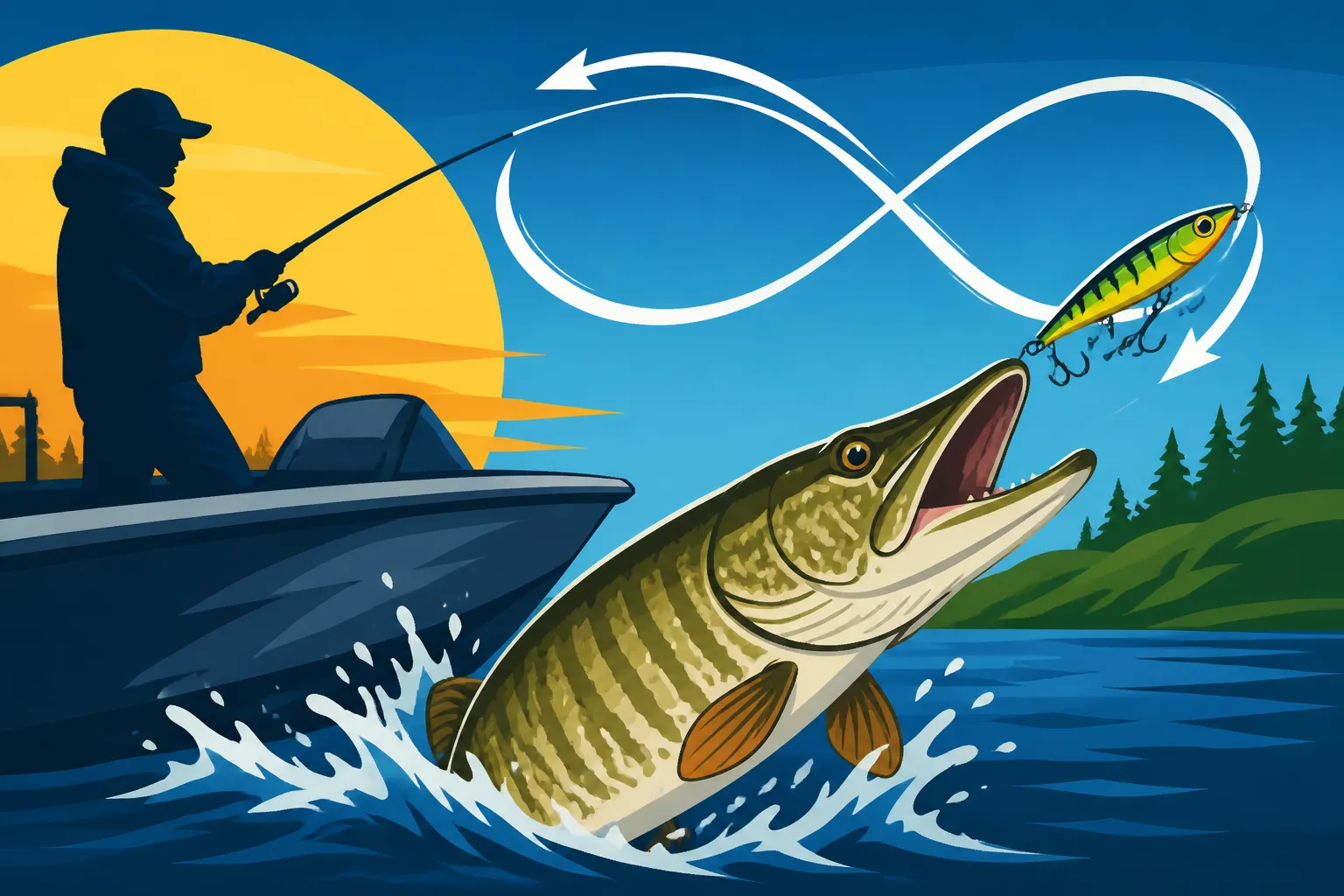
The moment you see that muskie follow, your actions need to be swift and smooth. Without lifting the lure out of the water, sweep your rod tip in a wide, horizontal circle. This is your first "loop" of the figure-eight. The key is to make this loop as wide as possible, effectively creating a large "U" shape in the water with your lure. The size of this loop matters; a small, tight loop might not be enough to entice a hesitant muskie, while a wide, smooth turn mimics a natural escape.
As you complete the first half of the "8," immediately transition into the second loop, crossing over the imaginary center line. Maintain consistent speed with your lure, letting your rod arm do all the work. Keep your eyes glued to the muskie. You're trying to lead the fish, keeping the lure just ahead of its nose. Don't lift your lure out of the water! The continuous movement is what sells the illusion to the muskie. The best way to visualize this is as if you're drawing a large "8" on the side of your boat, with the lure as your pencil. This continuous motion can be surprisingly hypnotic and often sparks a strike from even the most lethargic follower.
The Critical Pause and Acceleration
Sometimes, a continuous figure-eight isn't enough. The muskie might just keep following steadily, almost mockingly. This is where you can introduce a subtle change of pace to trigger a reactive bite. As you complete one of the "loops" or are about to switch directions, incorporate a momentary pause or a sudden acceleration. This isn't a full stop; it's more like a slight stutter or burst of speed, just for a split second, before resuming the smooth motion. This unexpected change can be the final trigger.
For example, as your lure reaches the tightest part of a turn in the figure-eight, give it a quick, short burst of speed, then immediately return to your normal retrieve speed. Or, just before you switch directions from one loop to the next, let the lure hang for a half-second, almost like it's momentarily stunned, then rip it into the next loop. These subtle variations can make a huge difference. Pay attention to how the muskie reacts. If it seems to be gaining on your lure or getting more aggressive, maintain speed. If it's lagging or seems uninterested, a quick change-up could be exactly what it needs to commit. Remember that the figure-eight can be performed at varying depths too, sometimes running it shallower, sometimes deeper, to match the muskie's position.
Common Pitfalls and Pro Tips for Boat-Side Muskie
Even with the best intentions, the figure-eight technique can be tricky to master. Many anglers make small errors that cost them a fish. Understanding these common mistakes and learning from experienced muskie hunters can drastically improve your success rate.
Avoiding Common Mistakes
One of the most frequent errors is making the figure-eight too small. In the heat of the moment, with a giant muskie staring you down, it's natural to panic and make small, jerky movements. However, small loops don't give the muskie enough room to turn and strike. You need wide, sweeping turns, often extending your rod almost as far as you can reach. Think big! Another mistake is stopping the lure too soon. The moment you see the muskie turn away, you might instinctively stop, thinking the opportunity is lost. Keep going for at least three to five full figure-eights, even if the fish seems to be losing interest. Often, that muskie will circle back for another look.
Anglers also sometimes fail to keep their eyes on the muskie. You're not watching the lure at this point; you're watching the fish. Its body language will tell you if it's getting ready to strike, if it's losing interest, or if it's just following out of curiosity. Adjust your speed and depth accordingly. Lastly, don't forget to keep your rod tip in the water. Lifting it out of the water breaks the continuous motion and often causes the muskie to abort. You can see many examples of the best fishing rods for these situations, including longer models ideal for figure-eighting, by searching on Amazon.
Gear That Supports the Technique
Having the right gear is non-negotiable for effective muskie fishing, especially when performing the figure-eight. A long, heavy-action muskie rod (8 to 9 feet is common) is crucial. This length allows you to create those wide loops and absorb the shock of a boat-side strike. A good quality baitcasting reel with a robust drag system, spooled with heavy braided line, is also essential. This setup provides the power and control needed to fight a large muskie quickly and safely.
Don't skimp on terminal tackle. A heavy-duty fluorocarbon or wire leader is a must to prevent bite-offs from those razor-sharp teeth. Swivels and snaps should also be of the highest quality. Finally, sharp, strong hooks on your lures are paramount. Muskie have bony mouths, and a dull hook will simply bounce off, turning a potential catch into another frustrating follow. Consider carrying a large, rubberized landing net specifically designed for muskie. While a Best Landing Net for Catfish might seem similar, muskie nets are generally much larger and deeper, designed to safely contain a thrashing monster.
Safety First
Muskie are powerful fish with sharp teeth and gill plates. A boat-side strike, especially during a figure-eight, can be incredibly violent and dangerous. Always be aware of your surroundings, especially if you're fishing with a partner. Have your tools—pliers, hook cutters, and a net—readily accessible. When a muskie does strike, be prepared for an explosive fight. Keep your body balanced and your footing secure.
Never reach into a muskie's mouth without proper tools, and always use a net to land the fish safely. If you're practicing catch and release, handle the fish as little as possible. The goal is to get a quick photo if you desire, and then release it back into the water promptly and safely. Knowing Iowa Muskie Season Dates and regulations is key, as is understanding how to safely handle these magnificent creatures to ensure their survival and future angling opportunities.
Integrating the Figure-Eight into Your Iowa Muskie Strategy
The figure-eight isn't just a Hail Mary; it's a fundamental part of the muskie angler's toolkit. It should be a planned, automatic extension of every single cast, particularly when targeting specific waters known for their trophy muskie populations, such as the Iowa Great Lakes or certain stretches of the Mississippi River.
When and Where to Employ It
The simple answer is: always. Every single cast, regardless of whether you've seen a follow or not, should end with a proper figure-eight. It's about developing muscle memory and being ready for that unexpected shadow. You might not see the muskie until the last second, or it might be a subtle follow that you almost miss. By making the figure-eight a routine, you ensure you're always giving yourself the best chance. This applies whether you're casting crankbaits, bucktails, jerkbaits, or soft plastics. Each lure type can be effectively worked in a figure-eight pattern.
Iowa offers some fantastic muskie fishing opportunities, particularly in lakes like Big Creek, Clear Lake, and the Iowa Great Lakes (Spirit Lake, West Okoboji, East Okoboji). The Mississippi River also holds a strong muskie population. These waters demand thorough coverage and a commitment to maximizing every retrieve. Incorporating the figure-eight into your routine on every cast is a testament to your dedication and will undoubtedly lead to more success over time. Think of it as extending your How to Catch Walleye at Night principle to muskie – always be prepared, even when you can't see what's lurking.
Practice Makes Perfect
Like any fishing technique, the figure-eight requires practice. Don't wait until a trophy muskie is behind your lure to try it for the first time. Practice the motion at home, in your yard, or even at the boat ramp before hitting the water. Get comfortable with the wide, sweeping motion, the rod angle, and the smooth transitions. You can even use a five-gallon bucket or a large pool to simulate the boat-side environment. This will build muscle memory, so when that moment of truth arrives, your movements will be fluid and natural, not hesitant or jerky.
Consider practicing with different lures to understand how they react during the figure-eight. Some lures might be easier to keep moving smoothly than others. Focus on maintaining continuous lure movement without it breaking the surface or snagging. Over time, the figure-eight will become second nature, an instinctive part of your muskie fishing approach. This dedication to practice, combined with a deep understanding of Iowa Fishing Regulations Explained, will undoubtedly elevate your game and increase your chances of landing that elusive Iowa muskie.
Here's a quick troubleshooting guide for your figure-eight attempts:
| Problem | Common Cause | Solution |
|---|---|---|
| Muskie turns away | Figure-eight too small or too slow | Widen your loops, increase speed, try a sudden acceleration or pause |
| Lure snags on boat | Rod tip too high, too much line out, bad angle | Extend rod further into water, keep lure just below surface, adjust position |
| Losing muskie focus | Distracted, not watching fish | Eyes on the muskie's nose, anticipate its movements, adjust presentation |
| Jerky movements | Panic, lack of practice | Practice dry runs, focus on smooth, wide, continuous motions |
| Rod feels too short | Inadequate reach for wide loops | Invest in a longer muskie rod (8ft+), readily available on Amazon |
| Fish ignores lure | No variation, too predictable | Experiment with deep/shallow figure-eights, subtle pauses, speed changes |
Beyond the Technique: The Mindset of a Muskie Angler
Successfully implementing the figure-eight technique goes beyond just physical execution; it demands a particular mindset. Muskie fishing, by its very nature, requires patience, persistence, and an unwavering belief that the next cast could be the one. When a muskie follows your lure, it's not a failure; it's an invitation, a challenge. The figure-eight is your opportunity to accept that challenge and turn a near-miss into a triumphant catch.
Understanding the Iowa Fishing License Guide is the first step, but honing specialized techniques like the figure-eight is what separates casual anglers from dedicated muskie hunters. It transforms the end of a retrieve from a simple reeling in to an active, engaging part of the hunt. This proactive approach, coupled with meticulous attention to detail and continuous learning, is the true spirit of muskie fishing in Iowa. Keep your rod tip down, your loops wide, and your focus sharp – that next giant might just be waiting for your perfect figure-eight.
The Adrenaline Rush of the Boat-Side Strike
There's nothing quite like the raw adrenaline of a muskie striking at the boat during a figure-eight. It's often a violent, explosive event that happens mere feet from your face. The fish, having been teased and led, suddenly decides to commit with terrifying speed and power. This close-quarters battle requires quick reflexes, a firm grip on your rod, and the ability to maintain composure. It's a moment that will forever be etched in your memory, a testament to your skill and persistence.
Even if you don't land every fish that strikes, the thrill of these boat-side encounters is why many anglers dedicate themselves to muskie fishing. It's the ultimate test of nerve and technique. Every time you cast, know that this moment could happen, and be ready to execute that perfect figure-eight. For more insights on general fishing strategies, checking out resources like Iowa Fishing Techniques Guide can provide a broader context for your muskie pursuits.
Celebrating the Catch (and the Release)
Finally, when you successfully land a muskie after a figure-eight, take a moment to appreciate the achievement. These are truly magnificent creatures, and catching one, especially after converting a follow, is a special accomplishment. Remember to prioritize the fish's health during handling and photography. A quick measurement, a few photos, and a gentle release ensure that these powerful fish continue to thrive in Iowa's waters.
If you're interested in other exciting fishing opportunities, you might enjoy learning about Walleye Fishing in Iowa or even Trout Fishing Techniques for Iowa Streams. Each species offers its own unique challenges and rewards, but the dedication and technique you've learned for muskie will serve you well across all of your angling adventures.
Disclaimer
This article is for general informational purposes only and does not constitute professional advice. Laws, prices and regulations vary by location and change over time. Consult a qualified professional for guidance on your specific situation.