How to Read a Fish Finder for Walleye
Feeling utterly lost when staring at your fish finder screen, seeing nothing but squiggles and wondering if walleye even exist down there? You’re not alone! Many Iowa anglers invest in this powerful tool only to feel overwhelmed by the sonar returns. This guide is here to demystify your fish finder, helping you translate those cryptic signals into clear insights, so you can confidently locate and catch those elusive walleye across Iowa’s diverse waterways.
Understanding the Basics of Your Fish Finder Display
Before you can truly "read" your fish finder for walleye, you need a solid grasp of what's actually being shown on the screen. It's not magic, it's science! Your fish finder sends out sound waves (sonar) that bounce off objects in the water – the bottom, structure, and, crucially, fish – and then return to the transducer. The unit then interprets these echoes and paints a picture on your screen.
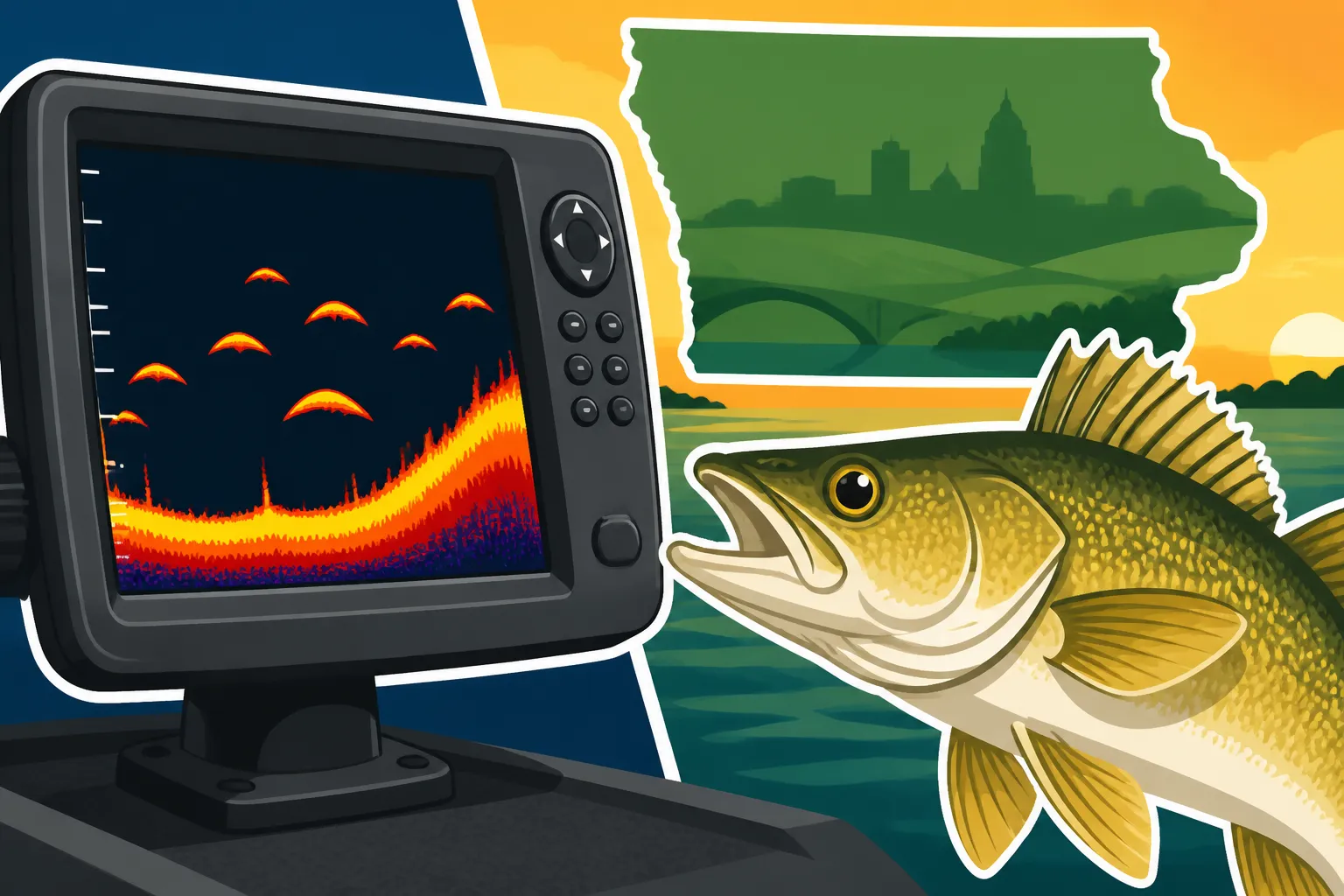
The display typically moves from right to left. What you see on the far right is happening right now, directly under your boat. As your boat moves or time passes, this "live" data scrolls to the left, creating a history of what your transducer has passed over. This scrolling view is critical for understanding patterns and identifying productive areas. Think of it like a continuous underwater movie, with the newest scene always on the right. Knowing this basic flow is the first step in avoiding that deer-in-headlights look when you glance at your unit.
Key Display Elements: Depth, Bottom, and Structure
Every fish finder, no matter how basic or advanced, will show you these fundamental elements. The bottom, usually the thickest, darkest band at the bottom of your screen, represents the lakebed or riverbed. Its thickness often indicates how hard or soft the bottom is – a thick, well-defined line often means a harder bottom, while a fuzzy, less distinct line might suggest softer mud or silt. Directly above this, you'll see "structure." This is anything from rocks and stumps to submerged trees and weed lines. Structure often appears as irregular shapes, humps, or vertical lines extending up from the bottom. Walleye love to relate to structure, using it for ambush points or protection from current. Knowing how to identify and interpret these bottom features is paramount, as it helps you pinpoint those walleye havens, whether you're fishing a deep hole in the Mississippi River or a submerged hump in Clear Lake. You can find a great selection of fish finders, from basic models to advanced units, on platforms like Amazon to get started.
Interpreting Arches and Marks
This is where many anglers get tripped up – the infamous "fish arches" or "fish marks." Historically, fish finders displayed fish as distinct arches. This happens when a fish enters and exits the cone angle of your sonar beam. As the fish enters the edge of the cone, you get one side of the arch. As it passes through the center, you get the peak, and as it leaves the other side, you get the other side of the arch. A full, strong arch typically indicates a fish that passed directly under your transducer. A partial arch or a "dash" might mean the fish was on the edge of the cone or you passed over it very quickly. Modern fish finders, especially those with down imaging or side imaging, may show fish as more realistic "blobs" or even clearer, almost photographic representations.
It's vital to remember that not every arch is a walleye, and not every walleye will produce a perfect arch. Smaller fish might show up as tiny dashes, while larger fish, like a trophy muskie, could create a huge, elongated arch. The key is to look for context: where are these marks in relation to structure? Are they near the bottom, suspended in the water column, or nestled in a weed line? These details will help you determine if they’re potential walleye targets or just baitfish.
Identifying Walleye-Specific Signatures on Your Screen
Walleye have distinct behaviors and preferred habitats, and understanding these will significantly improve your ability to identify them on your fish finder. They are often bottom-oriented, especially during the day, seeking cover and cooler water. However, they will suspend in the water column when actively feeding or following baitfish.
Depth and Location Cues
When targeting walleye in Iowa, paying attention to depth is crucial. In lakes like Rathbun Lake or the Iowa Great Lakes, walleye often hold to specific depth contours, especially along drop-offs, points, and humps. On your fish finder, you’ll want to watch for marks that are close to the bottom, often within a few feet of it, or directly associated with vertical structure like a submerged tree. If you see a cluster of arches suspended high in the water column in open water, these are more likely schools of baitfish, or perhaps species like white bass. However, if you see larger, more isolated arches near a deep-water hump at say, 20-30 feet, those are much more promising for walleye. Keep an eye on how deep you are fishing and relate any fish marks to those depths. Sometimes, walleye will suspend at a consistent depth over open water, especially during low light conditions or when actively chasing schools of yellow bass at Clear Lake.
Behavior Patterns and Schooling
Walleye are schooling fish, but not always in tight, massive balls like crappie or bluegill. You might see several distinct, larger arches or blobs grouped together on your screen, often near structure. If you see numerous small, dense marks, that’s more indicative of baitfish. A good walleye mark will typically be larger, more defined, and sometimes appear as a "double arch" if your boat passes directly over a larger fish, showing both the swim bladder and the fish's body separately.
Also, consider the time of day. Walleye are notoriously light-sensitive, so during bright daylight, they'll often hug the bottom or bury themselves deep within cover. Your fish finder might show them as "streaks" or "lines" directly on the bottom line, almost indistinguishable from the bottom itself. This is often referred to as "bottom hugging." In these scenarios, you're not looking for perfect arches but rather subtle bumps or changes in the bottom contour that appear "too defined" to be just mud. During dawn, dusk, or cloudy days, you might see them more actively suspending just off the bottom. Learning to differentiate these subtle clues comes with experience, but it’s a game-changer for finding How to Catch Walleye in Iowa.
Advanced Fish Finder Features for Walleye Anglers
Modern fish finders offer a dazzling array of technologies beyond traditional 2D sonar. Understanding these can give you a significant edge in locating walleye, especially in tricky conditions or unfamiliar waters. Many top brands like Humminbird and Garmin offer models with these advanced features.
Down Imaging and Side Imaging
Down Imaging (often called DownScan, ClearVü, or MEGA Down Imaging) provides a photo-like view directly beneath your boat. Instead of arches, you see objects, including fish, with much clearer definition. A walleye might appear as a distinct, banana-shaped blob with a shadow underneath, making it easier to differentiate from a submerged log. This is incredibly helpful for dissecting intricate structure like brush piles or rock gardens where walleye love to hide.
Side Imaging (SideScan, SideVü, MEGA Side Imaging) is perhaps the biggest game-changer for covering water and finding walleye. It sends sonar beams out to the sides of your boat, scanning a wide area – often 100 feet or more on each side. This allows you to literally "see" structure, baitfish, and individual walleye far away from your boat, without driving directly over them. You can spot a rock pile, a weed edge, or even a school of walleye holding to a point, then turn your boat and approach them stealthily. For fishing large Iowa reservoirs like Saylorville Reservoir, side imaging can drastically cut down your search time. You can often scout entire banks or humps quickly, identifying those prime walleye spots before you even make a cast. While it takes some practice to interpret, mastering side imaging will make you a much more efficient walleye angler.
Understanding Cone Angles and Frequencies
Your fish finder doesn't just send one straight beam down. It sends out a cone-shaped beam, and the angle of this cone (e.g., 20 degrees, 60 degrees) affects what you see. A narrower cone (higher frequency, like 200 kHz or MEGA Imaging) provides more detail and better target separation, especially in deeper water, making it easier to distinguish individual fish from structure. However, it covers a smaller area. A wider cone (lower frequency, like 83 kHz or 50 kHz) covers a much larger area, which is great for finding baitfish schools or covering expansive flats, but sacrifices some detail.
Many fish finders allow you to use dual frequencies or CHIRP sonar, which sends a range of frequencies, providing the best of both worlds – excellent detail and good coverage. For walleye, a narrower, higher-frequency beam is often preferred for identifying individual fish close to the bottom or structure, especially when jigging for Winter Walleye Techniques Near Dubuque. Experiment with your settings; sometimes running a wide beam for scouting and then switching to a narrower beam when you spot something promising is the best approach. You can find detailed guides and even accessories like alternative transducers for different cone angles on Amazon, which can enhance your unit's versatility.
Practical Tips for Walleye Anglers in Iowa
Reading a fish finder is a skill that improves with practice. Don't get discouraged if you don't immediately see big walleye arches every time you hit the water. It’s about learning to interpret the subtle clues and connecting what you see on the screen to what’s happening in the water.
Calibrating Your Unit and Adjusting Settings
First things first: make sure your unit is properly installed and calibrated. An improperly mounted transducer can give you skewed readings. Once that's squared away, learn your unit's settings. Sensitivity, gain, and color palette are your best friends.
- Sensitivity/Gain: This controls how much detail your sonar picks up. Too low, and you'll miss fish. Too high, and you'll get excessive clutter and noise. Start at about 70-80% and adjust up or down. You want to see the bottom clearly with a faint "thermocline" line if one is present, and clear fish arches if fish are around.
- Noise Rejection/Filter: These settings help clean up the screen by filtering out interference from your trolling motor, other boats' sonar, or rough water. Use them judiciously, as too much filtering can also obscure actual fish.
- Color Palette: Experiment with different color schemes. Some palettes make fish arches or bottom detail stand out more clearly for your eyes.
- Scroll Speed: A faster scroll speed (moving from right to left) gives you more real-time data but compresses the history. A slower speed shows more history but delays the real-time information. For actively searching, a faster speed is often better.
Learning these settings will allow you to fine-tune your display for different water depths, clarity, and fishing conditions, making it easier to spot walleye hiding in the weeds or along a deep contour. This knowledge is key for any serious angler exploring Iowa Fishing Techniques Guide.
What to Do When You See a Walleye Mark
Seeing a walleye mark is exciting, but it's just the beginning. The next step is to fish it effectively. If you see fish near structure or on a break, deploy your lure or bait precisely to that depth. Pay attention to how the fish react on your screen – do they move towards your bait? Do they scatter? Your fish finder isn’t just for finding fish; it’s a real-time observation tool.
If you're vertically jigging or dropshotting, you might even be able to see your lure on the screen, along with the fish's reaction. This is incredibly powerful for enticing reluctant walleye. If you see a fish that appears to be "stuck" to the bottom, try a subtle presentation right on the bottom, perhaps a jig and plastic dragged slowly. If they're suspended, present your bait at their eye level. Remember, walleye are often found in areas that offer both food and cover. If your fish finder lights up with walleye marks, make a mental note, or better yet, mark a waypoint on your GPS. This will help you identify patterns and return to productive spots later. This is especially useful when trying to understand Walleye Season and Size Limits as you hone in on legal fish.
| Sonar Return Type | Appearance on Screen | Likely Interpretation for Walleye Anglers | Action to Consider |
|---|---|---|---|
| Clear, Defined Arch | Strong, vibrant, full arc; often with a "shoulder" | Active, larger fish (likely walleye if in known habitat) | Target with presentation at depth of arch. |
| Bottom-Hugging Line/Bump | Thickening or small irregularity on the bottom line | Walleye relating tight to bottom, possibly inactive. | Drag jigs, Lindy Rigs, or slowly retrieve bottom-oriented baits. |
| Suspended Blob/Dash | Mid-water mark, often isolated | Walleye chasing bait or moving, especially at low light. | Cast crankbaits, suspend jerkbaits, or use a slip bobber. |
| Dense Cloud of Small Dots | Numerous tiny marks, often moving together | Baitfish school (walleye may be nearby). | Look for larger marks on the edges or underneath the cloud. |
| Distinct Structure (Down Imaging) | Clear image of brush pile, rock, or timber | Prime walleye ambush point. | Work lures precisely through and around the structure. |
| Side Imaging Return | Fish marks or structure to the side of the boat | Scouting tool to locate fish before driving over them. | Mark a waypoint, then approach and cast. |
Finally, don't forget the importance of what you can't see on the screen. Things like current seams, water temperature breaks, and subtle changes in bottom composition might not show up clearly, but they are often crucial walleye magnets. Use your fish finder as one tool in your arsenal, combining its insights with your knowledge of walleye behavior, local patterns, and even fishing reports. By doing so, you'll greatly increase your chances of finding and landing those fantastic Iowa walleye!
Disclaimer
This article is for general informational purposes only and does not constitute professional advice. Laws, prices and regulations vary by location and change over time. Consult a qualified professional for guidance on your specific situation.