Best Cooler Size for a Day of Fishing
There’s nothing quite like the satisfaction of a successful day on the water, whether you’re casting for bass in a secluded farm pond or drifting for walleye on a big Iowa reservoir. But that feeling can quickly turn to frustration if you’ve got a stringer full of beautiful fish and no place to keep them cool, or worse, if you’re lugging a cooler that's far too big and heavy for your modest catch. Finding the perfect cooler size for your day of fishing in Iowa isn't just about fitting your fish; it's about efficiency, freshness, and making your trip as enjoyable as possible. This guide will help you navigate the options and pick a cooler that’s just right for your next adventure.
Why Cooler Size Matters More Than You Think
It might seem like a simple decision, but the size of your cooler can genuinely impact your fishing experience. It’s not just about capacity; it’s about practicality, ice retention, and ultimately, the quality of your catch when you get home.
The Goldilocks Problem: Too Big, Too Small, or Just Right?
We’ve all been there: you head out for a day of fishing, optimistic about your chances, and come back with a few nice catches. Only to discover your cooler is either a glorified lunchbox, too small to accommodate even a modest walleye, forcing you to bend tails and compromise freshness, or it's a behemoth that dwarfs your actual haul. Trying to wedge a good-sized fish into a cooler that's too short is a real buzzkill after a successful Iowa Walleye Season Opening Day or a productive crappie bite. You're left trying to strategize how to keep them cold without ruining them, which isn't the kind of puzzle you want to solve after a relaxing day.
Then there's the opposite problem: bringing a cooler that's simply too large for your needs. This oversized cooler is a burden, adding unnecessary weight and taking up precious space in your boat, truck bed, or along the bank. It also demands a significant amount of ice just to fill its empty volume, which can melt faster if it's not packed efficiently. You end up lugging a heavy, cumbersome monster, feeling foolish when your catch consists of only a couple of fish.
The goal, much like Goldilocks, is to find that "just right" cooler. One that comfortably holds your expected catch, fits neatly into your transportation setup, and keeps everything perfectly chilled without becoming a source of stress or physical strain. This balance directly contributes to your comfort, ensures the quality of your fish, and enhances the overall enjoyment of your time outdoors, whether you're enjoying Shore Fishing Access Near Des Moines or venturing out on a large lake.
Impact on Ice Retention and Fish Freshness
Beyond mere capacity, cooler size plays a critical role in how long your ice lasts and, consequently, how fresh your fish remain. A cooler that's excessively large for the amount of fish and ice you're actually carrying will have a lot of empty air space. This open volume warms up much quicker than a densely packed space, accelerating ice melt and reducing the cooler's efficiency. It's a fundamental principle of thermodynamics that many anglers overlook.
Conversely, a cooler that is appropriately sized, packed tightly with a good ratio of ice to fish, creates a more stable and efficient thermal environment. Less air to cool means your ice lasts considerably longer, which is absolutely vital for preserving the freshness of your prized catches, like that Trophy Walleye Size in Iowa, from the first cast to the ride home, especially on hot summer days. The longer the ice lasts, the colder your fish stay, and the better they'll be when it's time for the dinner table.
Maintaining proper fish freshness isn't just about taste; it’s a matter of food safety. Even for a single day trip, fish need to be kept at consistently low temperatures to inhibit bacterial growth. A cooler that struggles to maintain ice for the duration of your trip is a recipe for potential disappointment and could even lead to wasted fish. Consider fishing one of the Iowa Great Lakes during a heatwave. The sun can be intense, and if your cooler's ice melts too quickly, those beautiful perch or walleye might not arrive home in the pristine condition you desire.
Factors to Consider When Choosing Your Day-Trip Cooler
Picking a cooler isn't a one-size-fits-all endeavor. Several key factors should influence your decision to ensure you select the best fit for your Iowa fishing adventures.
Anticipated Catch Size and Quantity
This is perhaps the most obvious consideration, but it warrants a detailed examination. Before you even head to the store, think about what you typically target and what you realistically expect to catch. Are you planning a day dedicated to accumulating a generous limit of panfish, or is your sights set on landing larger individual species like channel catfish, largemouth bass, or even the elusive muskie? A cooler perfectly suited for a limit of tasty bluegills will be fundamentally different from what you'll need for a 30-inch flathead catfish.
If your primary target species are panfish like crappie or bluegill, which often have fairly liberal daily limits in Iowa, you might anticipate keeping a good number of them. For these smaller fish, a cooler that is wider rather than exceptionally deep can be very effective, allowing you to lay them flat in layers and generously cover them with ice. This ensures even cooling and prevents them from getting crushed.
However, if you're chasing bigger game fish such as walleye, bass, or even adhering to the Muskie Daily Bag Limit on Border Waters, length becomes a critical factor. A cooler that is too short means you'll be faced with the unfortunate dilemma of bending or, even worse, cutting your fish to make them fit – a practice most anglers prefer to avoid if possible. When targeting larger species, it’s always wise to err on the side of a cooler with a bit more internal length than you think you might need, just to accommodate those unexpectedly big Iowa monsters.
Think specifically about the nature of your outing. If you're utilizing Iowa's Free Fishing Weekend Guide to introduce kids to fishing, you might end up with a varied bag of smaller species. In such a scenario, a versatile cooler that can handle a range of sizes, perhaps a medium-sized model, makes a good general-purpose choice, offering flexibility for whatever bites.
Length of Your Fishing Trip
The definition of "a day of fishing" can be quite broad. For some, it's a quick two-hour outing at a local pond, while for others, it's an epic, all-day adventure on the Mississippi River, stretching from pre-dawn until well after sunset. The longer you intend to be on the water, the more critical it becomes to choose a cooler with ample ice capacity, which isn't always the same as massive fish capacity.
For shorter trips, such as a casual morning or afternoon outing lasting just a few hours, a smaller, more portable cooler might be perfectly adequate, especially if you only plan to keep a couple of fish. In these situations, you won't need an enormous amount of ice, and the cooler's main job is simply to get your fish home fresh, not necessarily to maintain ice for 10 or more hours. A compact, efficient cooler can be a real asset here.
However, for full-day excursions, particularly during warmer weather, you'll definitely want a cooler that not only holds your anticipated catch but also enough ice to last the entire duration. This frequently translates to needing a slightly larger cooler overall, specifically to accommodate a greater volume of ice, even if your actual fish haul isn't going to be exceptionally large. More space for ice translates directly into significantly longer cooling times, making ice your most reliable ally against spoilage.
It’s important to note that if your plans extend beyond a single day – for instance, if you're camping overnight or embarking on a multi-day fishing trip – you're moving beyond the scope of a "day trip" cooler. For these longer adventures, you would typically look at premium, heavy-duty coolers specifically engineered for multi-day ice retention, which are generally much larger and more robust than what's needed for a simple day out.
Transportation and Storage Constraints
How you plan to transport your cooler to and from the water is a pivotal consideration. If you're hiking to a remote bank fishing spot, wading a trout stream, or navigating tight spaces in a kayak, portability becomes paramount. A large, unwieldy, heavy cooler quickly transforms from an asset into a massive hindrance, making your day far more work than it needs to be. In these scenarios, you might lean towards a smaller, lighter soft-sided cooler, or a hard cooler equipped with durable wheels for easier maneuverability.
For boaters, especially those with smaller craft like kayaks, canoes, or compact jon boats, space is always a premium commodity. A cooler that is overly bulky can obstruct your movement, significantly reduce valuable deck space, or even compromise the boat's stability and balance. It's wise to measure your available space precisely before committing to a cooler size. Knowing the Best Kayak Length for Iowa River Fishing might also inform how much cooler space you have.
Even if you possess a larger boat, consider the practicalities of loading and unloading your cooler. Will you typically be fishing solo, or will you have assistance from a fishing buddy? A cooler filled with ice and a decent catch can become incredibly heavy, making a size that's manageable for one or two people a very practical and important consideration for your back and effort.
And don't forget about how the cooler will fit into your vehicle. Can it be stowed in your trunk or back seat without obstructing your view or monopolizing passenger space? A long, slender cooler might be ideal for accommodating fish, but if it doesn't fit conveniently into your mode of transportation, then it's simply not a viable option for your trips.
Common Cooler Sizes and What They're Good For
Understanding the general size categories can help you visualize what might work best for your specific fishing needs. Here's a breakdown of common cooler sizes and their ideal applications for Iowa anglers.
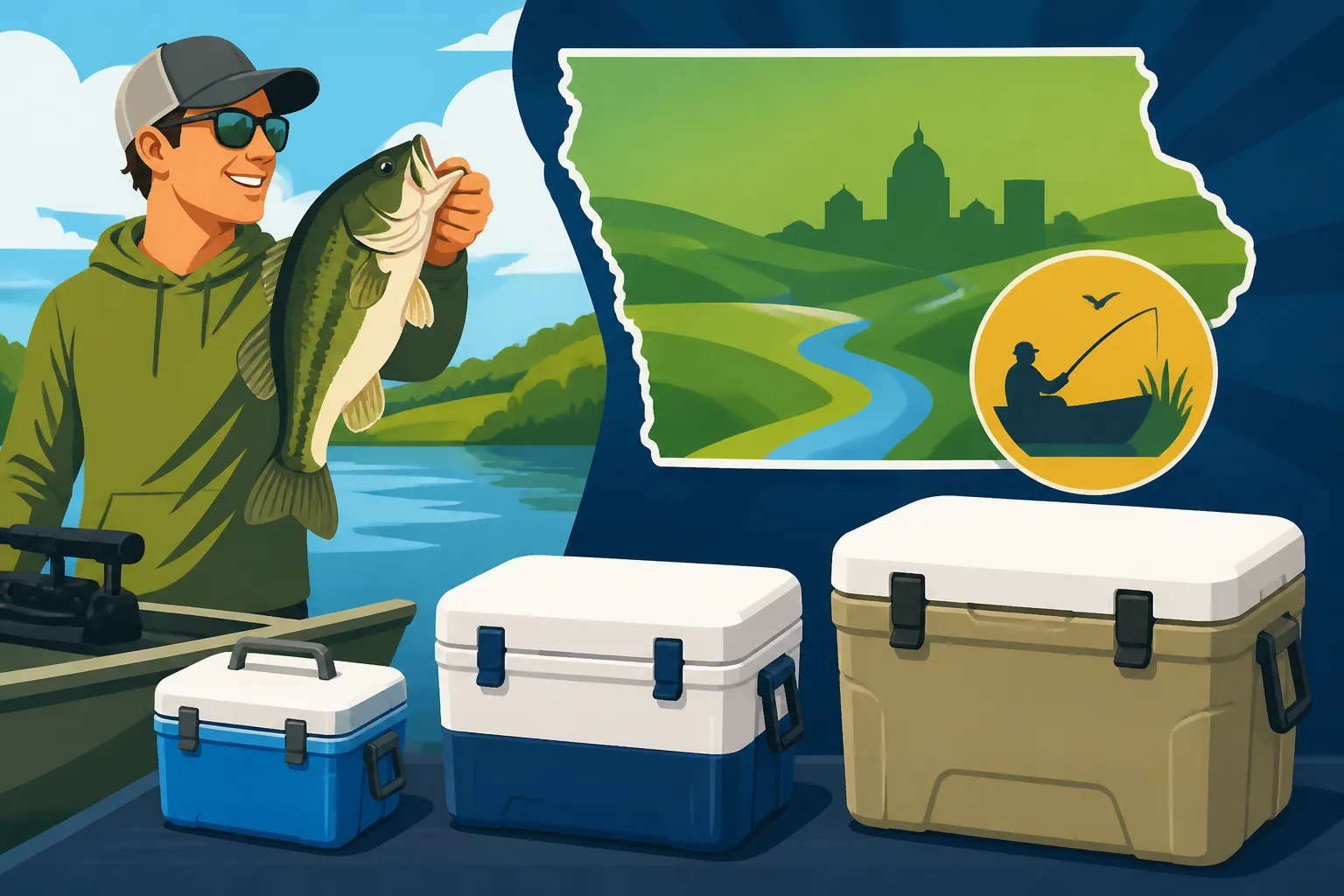
Small (10-25 Quarts / Approximately 8-20 Cans)
These compact coolers are the champions of ultra-light fishing days. Think of a quick, spontaneous trip to one of the Community Trout Ponds Near Des Moines, or a leisurely couple of hours at a quiet local farm pond. Their primary advantage is exceptional portability; they're incredibly easy to carry, fit into almost any small space, and are ideal for keeping a few drinks cold alongside a couple of smaller panfish or brook trout.
Small coolers are perfectly suited for solo anglers or for those wonderful parent-child outings where the main focus is on the joy of catching a few fish, rather than filling a huge limit. While they're certainly not designed to hold a substantial limit of larger game fish, they excel at convenience and being unobtrusive. You can often tuck a small tackle box and a few sandwiches inside, making it a self-contained unit for short excursions.
Many outdoor retailers, like Bass Pro Shops, offer a range of these smaller, personal-sized coolers that are perfect for tucking into the stern of a kayak or carrying a short distance from your vehicle. They typically hold just enough for a single angler's modest catch and a few essential refreshments. You can also find a vast selection on Amazon, often with varying features and price points.
It’s important to remember that due to their smaller volume and often thinner insulation compared to their larger counterparts, ice retention isn't usually their strongest suit. Therefore, these coolers are best reserved for shorter outings where you're not relying on ice to last for more than a few hours.
Medium (25-45 Quarts / Approximately 20-40 Cans)
This range often hits the sweet spot for the majority of day-trip anglers across Iowa. A cooler in the 35-quart range, for instance, offers an excellent balance between generous capacity and manageable portability. It's typically capable of comfortably handling a decent stringer of crappies or bluegills, or a couple of respectable walleye or bass, all without becoming overly cumbersome or difficult to handle.
Coolers in this medium size category are generally long enough to accommodate most common freshwater fish species you'll encounter on a typical Iowa outing, making them highly versatile. While a truly gargantuan muskie might present a challenge, most other game fish will fit without issue. Crucially, they also possess enough internal volume to hold a sufficient amount of ice to last a full day, even when fishing in warmer conditions, especially if you choose a quality model with good insulation.
Many experienced anglers consider this size their go-to for fishing from various small boats, including jon boats, or for longer bank fishing trips where you plan to stay set up for the better part of the day. They remain manageable for a single person to move when empty or lightly loaded, and some models even come equipped with wheels, which significantly aids in transport over longer distances.
If you're an Iowa Resident Annual Fishing License holder seeking a versatile cooler that can competently handle the vast majority of your day-to-day fishing adventures across Iowa's diverse waters, investing in a quality medium-sized cooler is very likely the most sensible choice. It truly strikes a superb balance between all the critical factors.
Large (45-70 Quarts / Approximately 40-70 Cans)
Now we're moving into the territory of coolers designed for more serious fishing endeavors, whether that means substantial hauls, longer, more intensive fishing days, or accommodating multiple anglers. A cooler in the 50-60 quart range provides a substantial capacity that can easily handle multiple limits of panfish, several larger individual species, or a diverse mixed bag from a highly productive outing on, say, Fishing the Mississippi River in Iowa.
These larger coolers are absolutely fantastic if you're regularly fishing with a group of friends or family, or if your primary objective is specifically targeting much bigger fish like large channel catfish, impressive flatheads, or if you anticipate filling a limit of longer species such as northern pike. They offer excellent internal length and depth, minimizing the need to bend or manipulate your catch.
The primary trade-off with coolers of this size, of course, is their portability. A 65-quart cooler, once filled with ice and a decent catch, becomes exceptionally heavy. You will almost certainly want to look for models equipped with robust wheels or plan on always having a fishing buddy to assist you with loading and unloading. These larger coolers are best suited for situations where you have a larger boat or where the distance and effort required for transport from your vehicle to your fishing spot are minimal.
While perhaps overkill for a casual, solo morning outing, for dedicated anglers who consistently bring home significant amounts of fish, or who spend long, hot days on the water requiring maximum ice retention for both refreshments and their catch, this size of cooler is often an indispensable piece of gear. They are perfect for multi-species trips where you might reel in a bit of everything Iowa's waters have to offer.
Here’s a quick overview to help you compare:
| Cooler Size Category | Approximate Capacity (Quarts/Cans) | Ideal Day Trip Use | Pros | Cons |
|---|---|---|---|---|
| Small | 10-25 Quarts / 8-20 Cans | Short, solo trips; keeping a few panfish or drinks. Quick stops. | Highly portable; lightweight; minimal space required; easy to grab and go. | Limited fish capacity; less effective ice retention for extended periods; unsuitable for large fish. |
| Medium | 25-45 Quarts / 20-40 Cans | Most single-angler full-day trips; couple of walleye/bass; good panfish limit. | Good balance of capacity & portability; decent ice retention for a full day; fits most common fish sizes. | Can become quite heavy when fully loaded; might be too small for large groups or very generous limits of big fish. |
| Large | 45-70 Quarts / 40-70 Cans | Group fishing; targeting large fish; multiple limits; long, hot days requiring maximum ice. | Excellent capacity for both fish and ice; superior ice retention capabilities; easily accommodates large species. | Very heavy when full, often requiring two people or wheels to move; bulky and takes up significant space; requires more ice to start. |
Cooler Features That Enhance Your Fishing Day
Beyond simply the size, a cooler’s design and specific features can significantly improve its performance and your overall experience on the water.
Insulation Quality and Construction
Not all coolers are created with the same level of effectiveness, and the internal construction is the single biggest determinant of how long your ice will actually last. When you’re shopping, actively look for coolers that boast thick, injected foam insulation throughout the entire structure – this means in the lid, all four walls, and the bottom. As a general rule of thumb, the thicker and denser the insulation, the more effectively it will prevent heat transfer and, consequently, the longer your ice will stay frozen.
High-end coolers, often referred to as rotomolded coolers, typically offer superior insulation and unparalleled durability. While they tend to be pricier and heavier, their seamless, single-piece construction is incredibly effective at preventing heat from leaking in or cold from leaking out, far surpassing the performance of cheaper, two-piece cooler models. This kind of investment truly pays dividends, especially when you are absolutely counting on your ice to last for the duration of a long, hot fishing day.
Gasket seals around the cooler lid are another absolutely critical feature. A high-quality, tight-fitting seal acts as an impenetrable barrier, keeping the precious cold air locked inside and preventing warm ambient air from infiltrating. Similarly, pay attention to the quality of the latches; they should be robust and designed to pull the lid down securely and tightly against the gasket. These superior sealing and latching mechanisms are hallmarks of premium coolers, and they genuinely contribute to significantly extended ice life.
While our primary focus here is on choosing the right size, opting for a cooler with excellent insulation quality can sometimes mean you can get away with a slightly smaller cooler. Its enhanced efficiency in holding ice might allow you to carry less overall volume, which can be a game-changer for specific fishing styles like Kayak Fishing Techniques in Iowa, where every inch of space and every pound of weight is a critical consideration.
Drainage, Handles, and Latching Systems
Imagine the end of a long, successful day fishing for Channel Catfish on the Mississippi River, and your cooler is full of water from melted ice and your catch. A well-designed drain plug, ideally a larger one that's easy to open and close, makes the process of emptying the melted ice water incredibly simple without the arduous task of having to tip over the entire heavy cooler. This functionality is especially crucial for maintaining an optimal ice-to-fish ratio throughout the day, ensuring everything stays as cold as possible.
Handles are another frequently overlooked but vital feature. Are they sturdy and securely attached? Do they offer a comfortable, non-slip grip, even when wet or cold? For larger coolers, robust, two-person handles are an absolute necessity for safe and easy transport. For smaller models, a single, strong handle with a comfortable grip is far more practical than flimsy alternatives. Well-designed handles prevent unnecessary strain and make moving your cooler much less of a chore.
Latching systems on coolers vary widely. Some entry-level models use simple plastic clasps, which can become brittle over time, while higher-quality coolers often feature heavy-duty rubber T-latches or durable cam latches. The superior the latching system, the tighter the seal it creates with the lid, and the less likely it is for the lid to accidentally pop open – a scenario that could lead to a catastrophic spill of ice and fish, something no angler wants to experience.
When you're thinking about those exciting day trips, perhaps to the rich waters of Rathbun Lake Fishing Guide or the popular Clear Lake Fishing in Iowa, you'll likely be loading and unloading your cooler multiple times. These well-thought-out features significantly streamline the entire process, making it smoother and much more enjoyable, transforming what could be a frustrating wrestling match with your gear into a seamless part of your angling adventure. Many anglers find durable, reliable cooler options at places like Bass Pro Shops or through the extensive selection available on Amazon.
Durability and Added Features
Fishing in Iowa can be unexpectedly tough on your gear. Whether you're bank fishing and potentially dragging your cooler over uneven terrain, or navigating the choppy waters of a lake where gear can get bumped around, your cooler needs to be able to withstand some abuse. Look for robust construction, reinforced hinges that won't easily break, and skid-resistant feet that keep the cooler stable on various surfaces. A good cooler represents a significant investment, and you want that investment to last through countless fishing seasons.
Some coolers come with a variety of extra features that, while not essential, can prove to be surprisingly useful. For instance, integrated rulers molded onto the lid are incredibly handy for quickly measuring your catch to ensure it adheres to Iowa Fishing Daily Bag Limits Guide and size regulations without the hassle of fumbling for a separate tape measure. Other convenient additions might include built-in cup holders, removable dry storage baskets for items you want to keep out of the ice water, or even integrated cutting boards for quick fish processing.
It's crucial to remember that while these added features can enhance your experience, they should never compromise the cooler's primary function: its ability to keep things cold and preserve your fish. Don't fall into the trap of sacrificing essential cooling performance for a fancy gimmick that you might rarely use. Prioritize insulation and sturdy construction above all else.
Ultimately, the best cooler size for your day of fishing in Iowa is a highly personal decision. It's the one that most perfectly aligns with your specific needs, the species you typically target, your chosen mode of transport to and from the water, and the expected duration of your angling adventures. By carefully considering all these factors, you'll be far better equipped to make a smart, informed decision that will serve you well for many memorable days on Iowa's beautiful waters.
Disclaimer
This article is for general informational purposes only and does not constitute professional advice. Laws, prices and regulations vary by location and change over time. Consult a qualified professional for guidance on your specific situation.