Minimum Length Limit for Bass in Iowa Public Lakes
The excitement of reeling in a beautiful bass on one of Iowa’s stunning public lakes is unmatched, but that quick adrenaline rush can often be followed by a moment of panic: "Is it big enough to keep? What are the rules here?" It can feel like you need a law degree to keep up with all the specific regulations, especially when they change from one body of water to the next. This comprehensive guide is here to clear up all the confusion surrounding the minimum length limit for bass in Iowa's public lakes, ensuring you're confident, compliant, and always ready for that next big catch.
Understanding Iowa's Bass Length Limits in Public Lakes
Iowa's approach to fishing regulations, especially for popular game fish like bass, is all about balance. The Iowa Department of Natural Resources (DNR) works tirelessly to ensure healthy fish populations for today and for future generations of anglers. This means you'll encounter a mix of statewide rules and hyper-specific local regulations designed to protect and enhance bass fisheries. Knowing these nuances is key to a successful and legal fishing trip.
The Standard Regulation for Largemouth and Smallmouth Bass
For a vast majority of Iowa's public lakes and rivers, the standard regulation for both largemouth and smallmouth bass is a 15-inch minimum length limit. This means any bass you catch that measures less than 15 inches from the tip of its snout to the end of its tail must be immediately released back into the water. This statewide rule, coupled with a daily bag limit of three bass, is designed to allow younger fish to grow to a mature size, reproduce, and contribute to the overall population before they are harvested.
This uniform approach across many waters simplifies things for anglers, but it’s crucial to understand that "most" doesn't mean "all." Imagine planning a fishing trip to a new lake; assuming the 15-inch rule applies is a good starting point, but always double-check. Breaking this rule, even accidentally, can lead to fines and penalties, which is the last thing anyone wants when they're out enjoying nature. It's not just about avoiding trouble; it’s about respecting the hard work that goes into managing these precious resources.
Special Regulations in Specific Waters
While the 15-inch minimum is widespread, Iowa also employs special regulations in certain public lakes to achieve specific management goals. These variations are often implemented to create trophy fisheries, protect unique spawning populations, or address specific ecological conditions of a particular lake. One common special regulation you might encounter is a protected slot limit, such as a 12-16 inch slot.
A protected slot limit can be a bit tricky if you're not used to it. For example, in some lakes like Big Creek Lake or Lake Macbride, the rule might state that bass between 12 and 16 inches in length must be immediately released. However, fish under 12 inches and fish over 16 inches can be kept, often with a modified daily bag limit (e.g., five bass daily, with only one over 16 inches). This kind of regulation helps protect the prime breeding stock, allowing them to grow larger and contribute more offspring, while still providing opportunities to harvest smaller, faster-growing fish or a single trophy. It's a nuanced approach, and it truly highlights why a quick check of the regulations for your specific destination is always a smart move.
Why These Limits Are in Place
These bass length limits aren't arbitrary rules cooked up by bureaucrats; they're based on sound fisheries science and conservation principles. The primary goal is to maintain healthy, self-sustaining bass populations across Iowa's waters. When you have a minimum length limit, it ensures that a significant portion of the fish population reaches reproductive maturity and has a chance to spawn multiple times before being harvested. This helps secure the next generation of bass.
Protected slot limits, on the other hand, are often used to cultivate trophy fisheries. By protecting the medium-sized, fast-growing fish, these regulations allow them to reach larger, more desirable sizes. This not only makes for more exciting fishing but also ensures that the genetic potential for large bass is passed on. These management strategies are vital for preventing overfishing, especially of prime breeding fish, and ensuring that Iowa's lakes remain vibrant and productive for bass anglers for years to come. Understanding the "why" behind these rules makes it much easier to embrace them as a responsible angler. To dive deeper into the overall framework, check out our guide on Iowa Fishing Regulations Explained.
Navigating Different Bass Regulations Across Iowa Waters
The diverse landscape of Iowa, from sprawling reservoirs to winding rivers and secluded ponds, means that a "one-size-fits-all" approach to fishing regulations simply wouldn't work. As a seasoned angler, you quickly learn that flexibility and a willingness to check local rules are just as important as your fishing technique. Bass regulations, in particular, can vary significantly depending on the type of water you're fishing.
Public Lakes vs. Private Ponds
One of the most common areas of confusion for anglers revolves around the distinction between public lakes and private ponds. Generally, the statewide and special regulations discussed earlier apply to public waters – those managed by the Iowa DNR or other public entities, like county conservation boards. These are the lakes you access with public boat ramps and shore fishing areas, and they are open to all licensed anglers.
Private ponds, however, operate under different rules. If a pond is entirely enclosed within private property and is not connected to any public waterways, the landowner typically has full control over fishing regulations, including length limits and bag limits. This means state fishing licenses might not even be required, and the landowner can set their own rules or have none at all. It's absolutely crucial to always obtain permission before fishing on private property and to clarify any specific rules the landowner might have. Don't assume anything; a friendly conversation can prevent misunderstandings. For more details on this, you might find our article on License Rules for Fishing on Private Property very helpful.
Catch-and-Release Only Zones
In certain situations, the Iowa DNR or local management authorities might designate specific areas or even entire bodies of water as "catch-and-release only" zones for bass. These zones are typically established for very specific conservation purposes, such as rehabilitating a struggling bass population, creating a protected spawning area, or fostering a truly exceptional trophy fishery where all large fish are returned to the water.
When you encounter a catch-and-release only designation, it means exactly that: every bass you catch, regardless of its size, must be released immediately and unharmed. There are no exceptions for trophy fish or smaller ones. These areas are often clearly marked with signage, and it's essential to respect these regulations wholeheartedly. They represent a concentrated effort to safeguard specific fisheries and often lead to incredible fishing experiences because the fish population is allowed to thrive untouched by harvest.
Border Water Rules
Fishing along Iowa's border rivers – the Mississippi River to the east and the Missouri and Big Sioux Rivers to the west – presents another layer of complexity. These waters are shared with neighboring states, leading to unique reciprocal agreements and distinct regulations that often differ significantly from Iowa's inland waters. For instance, the Iowa Fishing Regulations on the Mississippi River Border are often a blend of Iowa and Illinois or Wisconsin rules, and they can even vary by specific pool or section of the river.
On the Mississippi River, for example, largemouth bass might have a 14-inch minimum length limit, and the daily bag limit could be five, differing from inland Iowa's 15-inch minimum and three-fish bag. Smallmouth bass regulations can also vary, with some pools having no length limit at all. These rules are usually established through collaborative agreements between the bordering states to ensure consistent management across shared waters. Always consult the specific border water regulations provided by the Iowa DNR, or even the regulations of the adjacent state if you plan to fish near the border, to ensure full compliance. Our articles on Reciprocal Fishing Rules on the Mississippi River Border and Reciprocal Fishing Rules on the Missouri River Border can offer further clarification.
The table below provides a quick overview of how bass length and bag limits can change across different public water types in Iowa. Remember, this is a general guide, and specific regulations can always change, so always consult the latest Iowa DNR fishing regulations booklet before heading out.
| Water Type | Largemouth/Smallmouth Bass Length Limit | Daily Bag Limit | Notes |
|---|---|---|---|
| Most Public Lakes & Rivers | 15 inches minimum | 3 | Standard statewide regulation |
| Select Public Lakes (e.g., Big Creek, Macbride) | 12-16 inch protected slot | 5 | Can keep fish under 12", release 12-16", keep one over 16" |
| Community Ponds/Urban Waters | Often no length limit or 12 inches | Varies | Always check specific signage; rules vary greatly based on management goals |
| Mississippi River Border Waters | Largemouth: 14 inches minimum | 5 | Smallmouth: no length limit in some zones (e.g., Pool 9); always check specific pool regulations |
Practical Tips for Measuring and Handling Bass Responsibly
Fishing isn't just about catching fish; it's about doing so responsibly and ethically. When you're dealing with length limits, accurate measuring and careful handling are paramount, especially if you plan to release your catch. Being prepared with the right tools and knowledge not only keeps you compliant with regulations but also contributes directly to the health and vitality of Iowa's bass populations.
Accurate Measuring Techniques on the Water
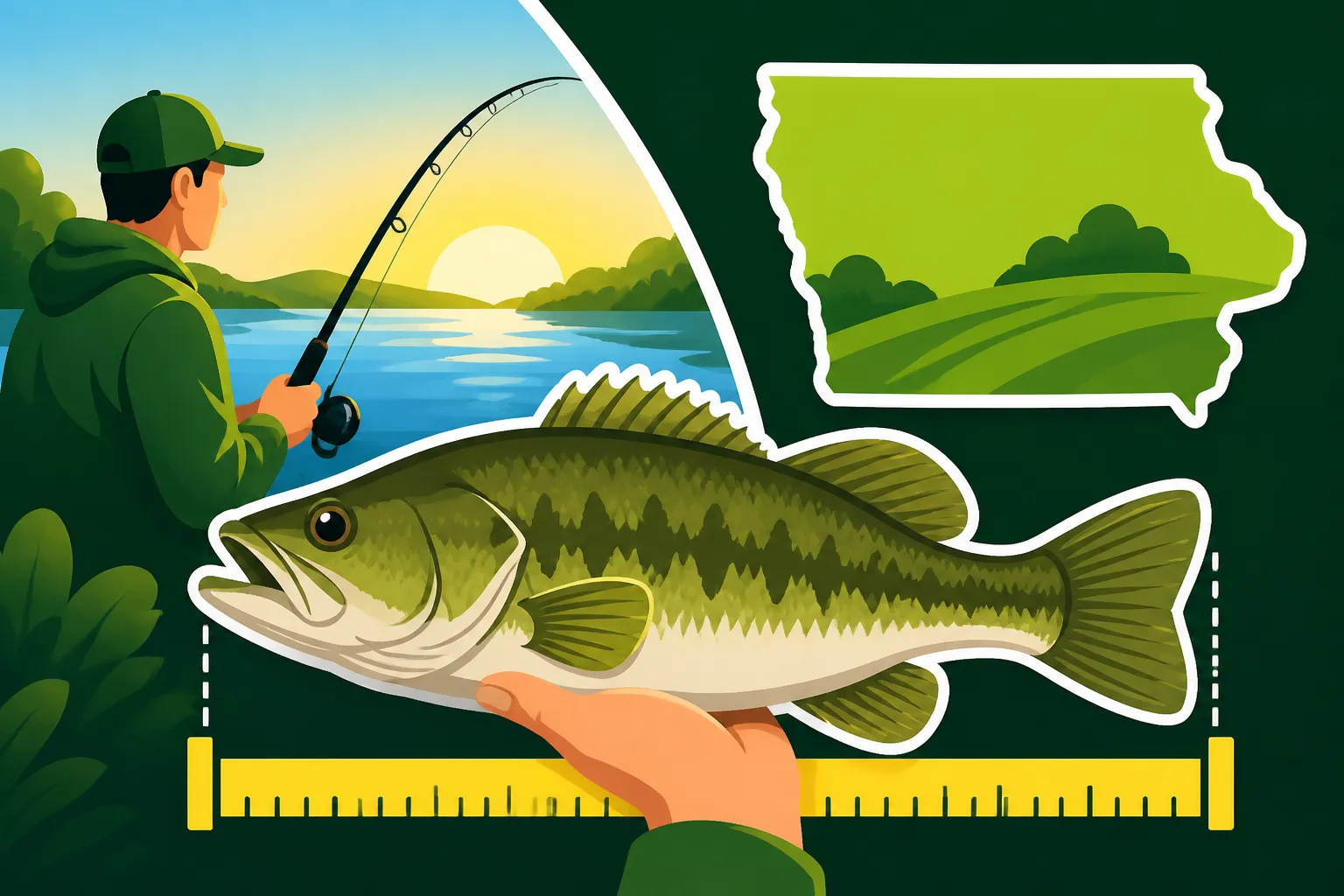
There's a right way and a wrong way to measure a fish, and when your catch is right on the line, accuracy truly matters. To measure a bass correctly, lay the fish flat on its side on a measuring board or tape. The measurement should be taken from the tip of its snout (mouth closed) to the very end of its tail, with the tail pinched to achieve the maximum length. Ensure the fish is straight, not curved, to get an honest reading.
Using a dedicated fish measuring board is by far the easiest and most accurate method. These boards often have a solid head stop and clear markings, making it simple to get a precise measurement quickly. You can find excellent, durable fish measuring boards on online retailers like Amazon from brands such as Rapala, Berkley, or TH Marine. Avoid using a flexible tape measure on its own, as it can be difficult to keep straight and accurately read with a wriggling fish. Keep your measuring device wet to protect the fish's slime coat, which is crucial for its health upon release. For general information on what gear you might need, our Iowa Fishing Gear Guide has plenty of suggestions.
Minimizing Stress for Healthy Release
If your bass doesn't meet the minimum length limit or if you're fishing in a catch-and-release only zone, releasing it safely and with minimal stress is your top priority. The goal is to get the fish back into the water as quickly as possible, in the best possible condition. Start by minimizing the time the fish is out of the water. Handle the fish with wet hands to protect its delicate slime coat, which acts as a barrier against disease. Avoid gripping the fish by the eye sockets or gill plates, as this can cause severe internal damage.
When holding a bass for a quick measurement or hook removal, support its body horizontally. Never hold a large bass vertically by its jaw, as its weight can cause irreversible damage to its internal organs and spinal column. Use a de-hooking tool or needle-nose pliers to remove hooks quickly and gently, especially if the fish is deeply hooked. If a fish is exhausted, take a moment to revive it by holding it gently in the water, facing into a mild current, until it can swim away under its own power. These simple steps dramatically increase the fish's chances of survival. Quality de-hooking tools, often found on Amazon, are small investments that make a huge difference for fish welfare.
Essential Gear for Responsible Bass Angling
Beyond your rod and reel, having the right supplementary gear can make all the difference in ensuring you're fishing responsibly and effectively. A sturdy landing net with a rubberized, knotless mesh is crucial for safely landing bass without damaging their fins or scales. The rubberized mesh prevents hooks from getting tangled, allowing for a quicker release.
Of course, a reliable measuring board, as mentioned earlier, is non-negotiable for adhering to length limits. Consider a quality pair of needle-nose pliers or a dedicated de-hooking tool to facilitate quick and safe hook removal. For those truly aiming to excel, a good quality fishing scale can be useful for weighing your catch before release, though it's optional for compliance. All these items are readily available from your local tackle shop or through online retailers like Amazon, ensuring you have everything you need for a responsible and enjoyable day on Iowa's waters. Equipping yourself with the right tools, detailed in guides like Fishing Rod and Reel Guide for Iowa Anglers and Best Tackle for Iowa Fishing, is part of being a true steward of the environment.
Disclaimer
Please be aware that fishing regulations in Iowa, including length and bag limits for bass, can change. While this guide provides comprehensive information based on current regulations, it is your responsibility to consult the most up-to-date official Iowa DNR fishing regulations before each fishing trip. These are typically available on the Iowa DNR website, at license vendors, or in a physical regulations booklet. Laws are subject to change, and staying informed ensures a legal and enjoyable angling experience.