Best Ice Fishing Line Weight
Oh, the crisp bite of an Iowa winter morning, the steam rising from your coffee, and the quiet anticipation as you stare down that hole in the ice. It’s a magical experience, isn’t it? But there's nothing more frustrating than feeling that subtle tap, setting the hook, and feeling… nothing. Or worse, feeling a solid fish on, only for your line to snap like a thread. Often, the culprit isn't your technique, but simply using the wrong line weight. This guide is here to untangle the confusion around choosing the best ice fishing line weight for Iowa's diverse waters and the incredible fish that call them home.
Understanding the Basics of Ice Fishing Line Weight
When we talk about line weight, we're referring to the "pound test" – the amount of force the line can withstand before breaking. In ice fishing, this choice becomes even more critical than open-water fishing, and it's something many anglers overlook. The unique conditions of ice fishing demand a careful balance between strength, sensitivity, and stealth.
Imagine trying to thread a tiny panfish jig, barely larger than your thumbnail, through a small hole in the ice with a thick, heavy line. It's clunky, unnatural, and completely kills the delicate action of your lure. Conversely, hooking into a hard-fighting walleye or a powerful northern pike with a line meant for bluegill is a recipe for heartbreak and a lost fish. The right line weight allows for proper lure presentation, increases your feel for those light bites, and provides the strength needed to land your quarry without unnecessary break-offs. It's about empowering you to fish smarter, not just harder, and truly make the most of those precious hours on the hard water.
The "Sweet Spot" for Panfish Bluegill, Crappie, Perch
If you're anything like me, some of your favorite ice fishing memories involve a bucket full of panfish. Those feisty bluegill, slab crappies, and tasty perch are often the bread and butter of an Iowa ice fishing trip. But these smaller fish, especially when the bite is light, can be incredibly finicky. This is where your line weight becomes paramount.
For panfish, the "sweet spot" typically falls between 2 and 4-pound test line. Let me tell you, going lighter here makes a world of difference. A 2-pound test line, with its ultra-fine diameter, allows those tiny jigs and micro plastics to swim and flutter with incredible realism. It's a stealth tactic; the fish are less likely to see the line, and the lure has a much more natural, enticing presentation. Think about how a live minnow swims – it's fluid and effortless. A heavy line will dampen that action, making your bait look stiff and unappealing.
Moreover, the lighter line significantly enhances sensitivity. When a bluegill just "mouths" your bait, or a crappie gently inhales it, that subtle difference in feel is much more apparent on a finer line. You'll feel those light pickups that you might otherwise miss with heavier line, leading to more hooksets and more fish on the ice. It’s a finesse game, and for panfish, finesse wins. When targeting these smaller species, especially on clear Iowa lakes like Big Creek Lake or the Iowa Great Lakes, a 2-pound test fluorocarbon leader paired with a very light main line can be absolutely deadly. You'll be amazed at the difference it makes when the bite is tough. For more on catching these tasty morsels, check out How to Ice Fish for Panfish.
Targeting Walleye, Northern Pike, and Larger Species
Now, let's talk about the heavy hitters of Iowa's ice fishing scene: walleye, northern pike, and even the occasional muskie (though those are rare and usually caught by accident through the ice!). When you're after these toothy, powerful predators, you need to step up your line game significantly. You simply cannot use a 2-pound test line when a 25-inch walleye or a thrashing pike takes your bait; it's just not going to hold up.
For these larger species, a line weight of 6 to 10-pound test is generally the recommended starting point. However, depending on the specific conditions and your target, some anglers will go even heavier, sometimes up to 12 or 15-pound test, especially for pike or when fishing near abrasive structure. The strength is crucial for several reasons. First, a solid hook set. When you're driving a hook into the bony mouth of a walleye, you need that backbone. Second, fighting power. These fish don't just swim away; they make powerful runs, head shakes, and dives, putting immense strain on your line. A heavier line gives you the confidence to fight the fish aggressively and bring it to the hole.
Another vital aspect is abrasion resistance. Northern pike, in particular, are notorious for their razor-sharp teeth that can easily fray or cut lighter lines. Even walleye, with their rough mouths and gill plates, can damage line during a prolonged fight. Heavier lines, especially those made of fluorocarbon or a robust monofilament, offer better protection against these hazards. When you're jigging for walleye on a deep reservoir like Saylorville, or waiting for a flag to fly for pike on a weed line, having the right Best Ice Fishing Line Weight is the difference between a triumphant catch and a frustrating loss.
Factors Influencing Your Ice Fishing Line Choice in Iowa
Choosing your line isn't just a matter of "small fish, light line; big fish, heavy line." Oh no, it's never that simple in fishing, is it? Several other crucial factors come into play, especially when you're battling the unique conditions of an Iowa winter. These elements can drastically influence whether that fish at the end of your line makes it up the hole or snaps off at the last second. Ignoring these nuances is like showing up to a deer hunt with a slingshot – you might get lucky, but you're probably going to be disappointed.
Water Clarity and Depth
The visibility of your line underwater is a massive factor, particularly in Iowa's diverse range of lakes and rivers. Some bodies of water, like many of our community trout ponds or the clearer sections of the Iowa Great Lakes, can have exceptional water clarity. In these gin-clear conditions, fish can be incredibly wary and line-shy.
When the water is clear, opting for a lighter, less visible line can dramatically increase your chances of getting bites. This is where fluorocarbon leaders really shine, as they are nearly invisible underwater. A fish that can easily spot your line might shy away from your perfectly presented bait, no matter how enticing it looks. This applies to all species, but especially to those notoriously finicky panfish and sometimes even pressured walleye. Going down to a 2-pound or 3-pound test, or adding a short fluorocarbon leader, can be the difference between a banner day and staring at an empty bucket.
Conversely, if you're fishing in murkier waters, perhaps a river backwater or a lake with higher turbidity, you might have a bit more leeway with line thickness. The reduced visibility means the fish are less likely to spook from a slightly heavier line. Deeper water also plays a role. As light penetrates less effectively at greater depths, the visibility of your line diminishes naturally. This means if you're targeting deep-water walleye in 30 feet of water, a 6 or 8-pound test line will be less noticeable than it would be in 5 feet of clear water. The key is to always match your line's stealth factor to the water conditions you're facing.
Lure Size and Type
Your choice of lure is intrinsically linked to your line weight, forming a delicate balance that dictates how effectively your bait performs underwater. It's a fundamental principle: the line should never overpower the lure's intended action.
Think about those tiny tungsten jigs often used for panfish. These are designed to be ultra-light, providing a slow, tantalizing fall and a subtle jigging motion. If you tie one of these minuscule baits to a heavy 8-pound test monofilament, that thick line will act like a heavy cable, completely stifling the jig's natural movement. The lure won't fall correctly, won't suspend naturally, and its delicate shimmy will be nonexistent. It's like trying to run a marathon in concrete boots – it just won't work. For these micro-jigs, a 2 to 4-pound test line is essential to let the lure dance and entice those light bites.
On the other end of the spectrum, consider a larger spoon or a hefty rattling rapala for walleye or pike. These lures have more weight and a more aggressive action. They can handle, and sometimes even benefit from, a slightly heavier line. A 6 to 10-pound test line won't inhibit their dive or their wide, flashy swimming motion. In fact, the added stiffness of a heavier line can sometimes even enhance the action of certain aggressive lures. Furthermore, when you're using larger lures with multiple hooks, you're often targeting more aggressive fish, which again leans towards needing more strength. Always hold your rod and lure and imagine it under the water. Does the line look proportional to the lure? Does it allow for optimal movement? If not, it's time to re-evaluate your pound test.
Ice Conditions and Structure
The environment you're fishing in on the ice also plays a significant role in your line choice. Iowa's winters can be variable, bringing everything from pristine, smooth ice to slushy, snow-covered surfaces, or even areas with submerged timber and thick weed beds. Each of these scenarios presents unique challenges to your fishing line.
When you're dealing with thick ice, especially if you're moving holes frequently, your line is constantly rubbing against the rough edges of the ice hole. This constant friction can quickly fray and weaken lighter lines. In these situations, a slightly heavier line with better abrasion resistance, or at least a strong fluorocarbon leader, can prevent frustrating break-offs right at the hole. The same goes for slush. Wet, chunky slush can get caught on your line as you reel up, creating friction and potentially weakening it over time. A smoother, slightly thicker line might handle these conditions better.
Fishing near structure – like submerged brush piles, standing timber, or dense weed beds – is often where the big fish hide. However, it's also where your line is most vulnerable. A hard-fighting fish can wrap your line around a snag in an instant, and if your line isn't strong enough, it's game over. For these scenarios, bumping up your line weight to 8 or even 10-pound test, especially with a tough fluorocarbon mainline or leader, can be a smart move. It gives you a fighting chance to pull that fish out of the cover and away from potential snags. Always assess the underwater landscape before you drop your line; knowing what challenges your line might face will help you make the best choice.
Types of Ice Fishing Line and Their Ideal Applications
Just like there isn't one perfect lure for every fish, there isn't one perfect line for every ice fishing situation in Iowa. The material your line is made of drastically impacts its performance, and understanding the strengths and weaknesses of each type is key to maximizing your success. It's not just about the pound test, but about how that line interacts with the water, the cold, and the fish.
Monofilament Line for Ice Fishing
Ah, trusty monofilament – the old reliable. For many years, and still for many anglers, monofilament (often just called "mono") has been the go-to line for ice fishing. It's relatively inexpensive, widely available, and generally easy to work with, even in freezing temperatures.
One of the biggest advantages of monofilament is its stretch. This inherent elasticity acts as a shock absorber, which can be a real blessing when a fish makes a sudden, powerful run or when you set the hook a little too hard. That give in the line can prevent hooks from tearing out of a fish's mouth, especially with panfish that have delicate mouths. Mono also tends to be quite forgiving with knots, holding them well if tied correctly. It's also fairly supple, meaning it handles well on spinning reels and isn't prone to developing excessive "memory" (coiling) if spooled properly and refreshed regularly. When you're bundling up and heading out to a spot you found on the Iowa Fishing Atlas Access Points, you can grab a spool of reliable mono easily from any tackle shop or even online.
However, monofilament does have its downsides. It's generally more visible underwater than fluorocarbon, which can be an issue in clear water or with line-shy fish. It also absorbs water, which can lead to it freezing and becoming stiff, especially the top layers on your spool or near your guides. This freezing can hinder line flow and make detecting subtle bites difficult. For general panfishing in waters that aren't overly clear, or as a cost-effective option for beginners, mono in 2-4 pound test can certainly get the job done. Just be mindful of its stretch and visibility in finesse situations.
Fluorocarbon Line and Leaders
If monofilament is the old reliable, then fluorocarbon is its stealthier, more sensitive cousin. This line type has truly revolutionized many aspects of fishing, and ice fishing is no exception. Fluorocarbon's properties make it an outstanding choice for specific scenarios on the hard water.
The number one reason anglers reach for fluorocarbon is its near invisibility underwater. It has a refractive index very close to that of water, making it incredibly difficult for fish to detect. This is a massive advantage when targeting line-shy fish in clear Iowa waters or when the bite is exceptionally tough. Imagine fishing a pressured lake, and suddenly, you start getting bites while others aren't. Often, the difference is a subtle switch to a fluorocarbon leader or even a full spool of fluorocarbon. Beyond invisibility, fluorocarbon is also incredibly abrasion-resistant. This is a huge benefit when fishing around sharp ice edges, submerged timber, or in areas where toothy critters like pike might be present. It also has very low stretch, which translates to excellent sensitivity. You'll feel those light pecks and subtle changes in your lure's weight more clearly, leading to quicker reactions and more hooksets. Another plus is that it doesn't absorb water, so it remains supple and less prone to freezing and stiffening in the cold. You can find a wide range of fluorocarbon line options on Amazon, making it easy to experiment with different brands and pound tests.
While fluorocarbon offers significant advantages, it does have a few drawbacks. It's generally stiffer than monofilament, which can make it a bit more prone to memory and can be harder to manage on smaller spinning reels, especially in lighter pound tests. It can also be more challenging to tie knots with, requiring specific knot types and careful cinching to avoid weakening the line. And typically, it's a more expensive option than monofilament. Many anglers find the best of both worlds by using a main line of braided line (which we'll discuss next) and then tying on a short fluorocarbon leader of 2-6 feet. This gives you the sensitivity of braid and the invisibility and abrasion resistance of fluoro right where the fish sees it. For trout fishing in Iowa's cold streams, for example, a fluoro leader is practically essential, as discussed in Trout Fishing Techniques for Iowa Streams.
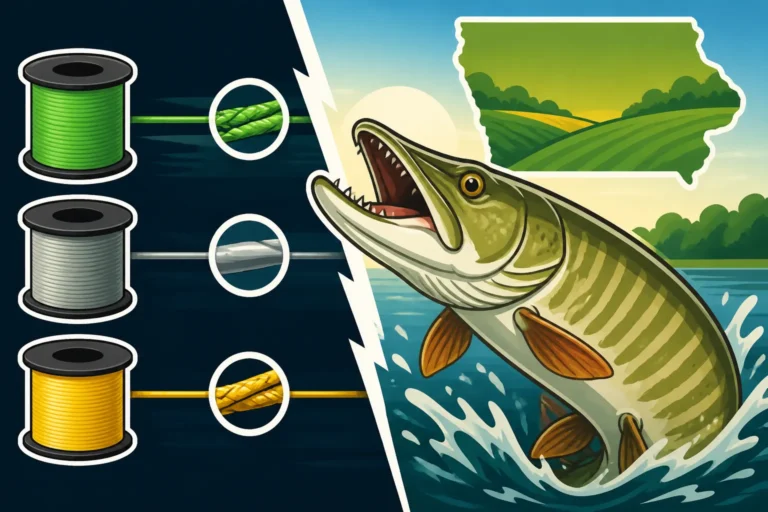
Braided Line for Sensitivity and Strength
Braided line is a game-changer for many ice anglers, particularly when targeting deeper water or larger, more aggressive fish. While it might seem counterintuitive due to its high visibility, its benefits often outweigh this perceived disadvantage, especially when used correctly.
The primary allure of braided line is its incredible strength-to-diameter ratio and its absolute lack of stretch. Imagine a line that's stronger than mono or fluoro of the same diameter, allowing you to use a thinner line that cuts through the water better, while still having immense power. The no-stretch property means unparalleled sensitivity. Every tick, every rock, every subtle movement of your lure, and most importantly, every single bite, is transmitted directly to your rod tip. You feel everything. This is a huge advantage when ice fishing, where bites can often be incredibly light and detecting them quickly is crucial for success. Additionally, braided line has virtually no memory, so it comes off the spool smoothly with no coiling, making for less tangles and better line management. It's an excellent choice when you're using heavy lures or jigging aggressively for species like walleye, as explored in Jigging Techniques for River Walleye.
However, braid isn't a perfect solution on its own. Its high visibility is a concern, as fish can easily spot it. To combat this, a fluorocarbon leader is almost always a necessity with braided mainline. This setup allows you to leverage the braid's sensitivity and strength while presenting an invisible line to the fish. Another potential issue in ice fishing is that braided line can absorb water between its fibers, which can then freeze. This can lead to the line stiffening, creating ice chunks on your reel, or even freezing to the inside of your rod guides, hindering line flow. To mitigate this, many anglers use line conditioners or avoid spooling braid all the way to the top of their reels. Despite these considerations, the benefits of braid for sensitivity and sheer power, especially when paired with a good fluorocarbon leader, make it a top choice for serious ice anglers. You can find high-quality braided lines and the fluorocarbon needed for leaders at stores like Bass Pro Shops.
Practical Tips for Choosing and Managing Your Ice Fishing Line
Okay, so we've covered the different types of line and the factors that influence your choice. But knowing is only half the battle, right? Putting it all into practice, and making sure your line is in tip-top shape, can make all the difference on the ice. These practical tips are born from years of experience and countless cold mornings spent on Iowa's frozen lakes and rivers. They're designed to help you not just choose the right line, but also maintain it for peak performance throughout the season.
Matching Line to Your Rod and Reel
Think of your ice fishing setup as a finely tuned instrument; each component needs to work in harmony with the others. Your line weight choice isn't just about the fish, but about balancing it with your rod and reel. A mismatched setup can lead to frustration, poor lure presentation, and ultimately, fewer fish.
An ultra-light ice fishing rod, typically used for panfish, is designed with a delicate tip and a flexible backbone to handle light lures and detect subtle bites. Spooling this rod with heavy 8-pound test line would completely overpower it. The rod wouldn't load properly on the cast (or rather, drop), the lure's action would be stifled, and you'd lose all that precious sensitivity. Conversely, putting a 2-pound test line on a medium-heavy rod designed for jigging walleye would be equally problematic. The thin line wouldn't stand up to the powerful hooksets, the larger lures wouldn't cast efficiently, and you'd risk immediate break-offs with a hard-fighting fish. The rod's stiffness demands a stronger line to effectively transfer power.
The reel also plays a role. Smaller, lighter spinning reels are designed for fine lines and small lures. Overfilling them with too heavy a line can lead to tangles, poor line lay, and decreased casting distance (again, dropping distance in ice fishing). Always check your rod's recommended line weight range, which is usually printed just above the handle. This is your guiding principle. Matching your line weight to the specific action and power of your rod, and the capacity of your reel, creates a balanced system that optimizes lure presentation, bite detection, and your ability to fight and land fish. For more on selecting the right gear, consider looking at Best Ice Fishing Rod Length.
Regular Line Inspection and Replacement
This might sound like a no-brainer, but it's astonishing how many anglers neglect their fishing line until it's too late. Ice fishing is particularly harsh on line, and regular inspection and replacement are non-negotiable if you want to avoid heartbreaking break-offs. The cold, the constant rubbing against ice, and the general wear and tear take their toll far more quickly than in open water.
Before every outing, and periodically throughout the day, take a moment to run your line through your fingers, especially the last few feet near your lure. Feel for any nicks, abrasions, or rough spots. These weak points are accidents waiting to happen. Ice can be surprisingly sharp, and even small imperfections in your line can be catastrophic when you're fighting a fish. If you feel any damage, don't hesitate: cut off the affected section and re-tie your lure. It's a small investment of time that can save you a trophy fish.
Beyond daily checks, your ice fishing line needs to be replaced more frequently than your open-water line. Monofilament, especially, can degrade over time due to UV exposure (even in winter, though less so), cold, and water absorption. Fluorocarbon is more durable but can still suffer from abrasion. Braided line is highly durable but the fibers can fray. As a general rule, many serious ice anglers will respool their primary ice fishing setups at least once a season, if not more frequently for heavily used rods. If you notice your line becoming brittle, losing its color, or coiling excessively, it's definitely time for a fresh spool. Don't let a few dollars worth of line cost you the fish of a lifetime on an Iowa lake.
Understanding Pound Test vs. Diameter
When you're comparing lines, it's easy to just look at the pound test and assume all 6-pound test lines are created equal. However, this isn't always the case, and understanding the difference between pound test and diameter can give you a significant edge in your ice fishing strategy.
Line manufacturers use different materials and extrusion processes, which means a 6-pound test line from one brand might have a slightly larger or smaller diameter than a 6-pound test line from another brand. Why does this matter? Well, a thinner diameter line offers less resistance in the water, allowing your lures to sink faster and maintain their action more effectively. This is especially important when you're fishing small, light jigs for panfish, where every bit of natural movement counts. A thinner line also cuts through the water column with less drag, which can aid in bite detection in deeper water by minimizing the "bow" in your line.
Moreover, the diameter can affect how the line handles in freezing conditions. A thicker line, especially monofilament, has more surface area to absorb water and is more prone to freezing and stiffening, making it harder to manage through your rod guides and out of the hole. Thinner lines, while still susceptible, tend to fare a bit better in extreme cold. While pound test is your primary indicator of strength, always keep an eye on the diameter specifications if you're comparing lines. Sometimes, sacrificing a tiny bit of perceived strength for a significantly thinner diameter can lead to a much more effective and enjoyable ice fishing experience, particularly for finesse presentations.
| Fish Species | Recommended Line Weight (Pound Test) | Preferred Line Type | Key Considerations |
|---|---|---|---|
| Bluegill/Crappie | 2-4 lb | Mono, Fluorocarbon (or Braid + FC Leader) | Stealth, sensitivity, natural lure presentation |
| Perch | 3-5 lb | Mono, Fluorocarbon (or Braid + FC Leader) | Stealth, subtle bite detection |
| Walleye | 6-10 lb | Fluorocarbon, Braid + FC Leader | Strength for hookset/fight, abrasion resistance, sensitivity |
| Northern Pike | 8-15 lb | Braid + FC Leader, Heavy Mono | Tooth resistance, strength, fighting power |
| Catfish (ice) | 10-20 lb | Braid + FC Leader, Heavy Mono | Sheer strength, abrasion resistance (bottom fishing) |
Disclaimer
This article is for general informational purposes only and does not constitute professional advice. Laws, prices and regulations vary by location and change over time. Consult a qualified professional for guidance on your specific situation.